
You want to start a US LLC. You are not a US resident. You have narrowed your choice to two states. Nevada or Texas.
This is a smart position to be in. Both states offer compelling advantages. But they serve different needs.
When I first visited Las Vegas, Nevada, it was all about hospitality, entertainment, casinos, shows and glamour. From my local friends I learned about places where you can shop very well because of the tax advantages. But beneath the neon lights and tourist attractions, I discovered something else. A sophisticated business infrastructure designed for privacy and asset protection. Nevada was not just about gambling and shows. It was about serious business structures.
Texas I knew from the TV series Dallas in the 1980s. Oil fields and farms for raising bulls. That image stayed with me for years. But when I visited Texas decades later, everything had changed. Today it is about entrepreneurs, techies, and forming your company there. Austin has become a technology hub. Houston remains an energy capital but now includes renewable energy and advanced manufacturing. Dallas and Fort Worth attract Fortune 500 headquarters. The business landscape transformed completely.
I have formed companies in both Nevada and Texas for international clients. I understand what works and what does not. Let me walk you through the real differences.
- Nevada vs Texas: The Core Differences
- Privacy: Who Sees Your Name
- Legal Framework and Asset Protection
- Tax Treatment: What You Actually Pay
- For Non Residents: What Really Matters
- Known Companies in Each State
- Route to Stock Market and IPO
- Decision Framework: Which State For You
- How 1Stop Connect Helps
Nevada vs Texas: The Core Differences
Before diving into details, understand the fundamental distinction between these states.
Nevada: The Privacy and Protection State
Nevada built its reputation on privacy. When you form a Nevada LLC, member names do not appear on public record. The state filing shows your company name, registered agent, and registered office address. That is it.
Your name as owner stays private. Your personal address stays private. This is not a loophole. This is how Nevada law works by design.
Nevada also established a Business Court in 2015. This specialized court handles corporate disputes with judges trained in business law. Not as established as Delaware's Court of Chancery, but far better than general courts in most states.
The state has strong asset protection laws. Charging order protections prevent creditors from easily seizing your LLC ownership. This matters if you hold real estate or significant assets through your LLC.
But Nevada costs more. For businesses with revenue exceeding $4 million annually, Nevada imposes a commerce tax.
Texas: The Cost Leader and Dexit Destination
Texas offers something remarkable. After you pay the initial $300 filing fee, there are no annual state fees. Zero. No annual report. No franchise tax for LLCs. No ongoing compliance costs to the state.
This makes Texas the lowest cost state for LLC maintenance in the entire United States.
Texas became nationally prominent in 2024 when SpaceX moved its state of incorporation from Delaware to Texas. Elon Musk announced this on social media in February 2024, stating the move was a response to Delaware court rulings.
Tesla is planning a shareholder vote to follow SpaceX to Texas. This Dexit movement (Delaware Exit) signals Texas emerging as a credible alternative to Delaware for major corporations.
Texas has the second largest state economy in the United States. GDP of $2.4 trillion. More Fortune 500 headquarters than any state except New York and California. AT&T, ExxonMobil, American Airlines all call Texas home.
The limitation is privacy. Member names appear on the Certificate of Formation. When you file with the Texas Secretary of State, organizer names become public record. Less privacy than Nevada or Wyoming.

Privacy: Who Sees Your Name
Privacy differs significantly between these states. Let me explain exactly what information becomes public.
Nevada Privacy Protections
Nevada does not require member or manager names on the Articles of Organization. The public filing contains only the LLC name, registered agent name and address, and the name and signature of the person filing (often the registered agent).
Your name as owner does not appear anywhere in public records. Someone searching Nevada business records will find your company name and registered agent. They will not find you.
Nevada allows nominee managers. You can appoint a nominee to serve as the public face of your LLC while you maintain actual control through the operating agreement. This adds another privacy layer.
The state maintains an internal list of beneficial owners for law enforcement purposes. But this information is not public. Banks will know who owns the company. The IRS will know. But competitors, litigants, and the general public will not.
Texas Privacy Reality
Texas requires more disclosure. The Certificate of Formation must list the organizer's name and address. If members are managing the LLC, their names appear as well.
This information becomes part of the public record. Anyone can search the Texas Secretary of State database and see who formed the company.
You can use a nominee organizer to keep your name off the initial filing. But if you are managing the LLC directly, your role as manager may require disclosure in subsequent filings or annual amendments.
Texas privacy is workable but not as strong as Nevada or Wyoming. For many businesses, this level of privacy is sufficient. For high net worth individuals, competitive industries, or those seeking maximum anonymity, Nevada provides better protection.
Federal Beneficial Ownership Rules
Both states are subject to federal beneficial ownership reporting requirements under the Corporate Transparency Act. As of 2024, most LLCs must report beneficial owners to the Financial Crimes Enforcement Network (FinCEN).
This information goes to federal authorities. It is not made public. The state level privacy protections still matter because they control what appears in publicly searchable state databases.
No US state provides complete anonymity. Banks need to know who owns the company. The IRS needs to know. Federal authorities need to know. Privacy protections limit public disclosure, not government disclosure. If you are involved in illegal activity, these protections will not help you.
Legal Framework and Asset Protection
The legal environment differs between Nevada and Texas. This impacts how disputes are resolved and how well your assets are protected.
Nevada Business Court
Nevada created its Business Court in 2015. This is a specialized court within the Eighth Judicial District Court in Las Vegas. Judges assigned to the Business Court receive specialized training in corporate and commercial law.
The court handles contract disputes, corporate governance issues, partnership disagreements, and business torts. Cases are heard by judges, not juries. This provides more predictable outcomes than general courts.
The Business Court is not as established as Delaware's Court of Chancery. Delaware has over 200 years of corporate case law. Nevada is building its precedent. But for most LLC disputes, the Nevada Business Court provides adequate sophistication.
Nevada also has strong LLC statutes. The state explicitly provides charging order protection. If a creditor obtains a judgment against an LLC member, the creditor's remedy is limited to a charging order. The creditor cannot force liquidation of the LLC or seize assets directly.
This makes Nevada attractive for asset protection strategies, particularly for real estate holdings or investment portfolios held through LLCs.
Texas Legal System
Texas does not have a specialized business court. Commercial disputes are heard in general district courts. Judges may or may not have significant corporate law experience.
Texas has solid LLC statutes but they are more standard. Charging order protection exists but is not as explicitly strong as Nevada's provisions.
For most small to medium businesses, the Texas legal framework is perfectly adequate. You get liability protection. You can enforce contracts. Disputes are resolved through normal court processes.
The limitation appears when you need sophisticated corporate law interpretation or when asset protection is a primary concern. In those situations, Nevada or Delaware provide better legal infrastructure.
Asset Protection Comparison
Nevada ranks among the top states for asset protection. The charging order limitation, combined with privacy protections, makes it difficult for creditors to pursue LLC assets.
Texas provides standard asset protection. Better than some states, not as strong as Nevada or Wyoming. For most businesses, this is sufficient. For high net worth individuals or those in litigious industries, Nevada offers superior protection.

Tax Treatment: What You Actually Pay
Both states market themselves as tax friendly. But the details matter.
State Income Tax
Neither Nevada nor Texas has state income tax. This is a major advantage. Your LLC profits pass through to you as the owner. You pay federal income tax. But there is no additional state level income tax on those profits.
This is true regardless of where you live. The LLC formed in Nevada or Texas does not pay Nevada or Texas state income tax. Even if you are not a US resident, this benefit applies.
Franchise Tax
Texas eliminated franchise tax for LLCs. In the past, Texas imposed a margins tax on certain businesses. As of recent reforms, LLCs are generally exempt from franchise tax.
Nevada also does not have a traditional franchise tax for LLCs. However, Nevada requires an annual business license fee, plus an annual list filing fee.
Texas costs zero beyond the initial formation.
Commerce Tax in Nevada
Nevada imposes a commerce tax on businesses with Nevada gross revenue exceeding $4 million in a fiscal year. The tax rate ranges from 0.051% to 0.331% depending on business category.
Most small businesses never reach the $4 million threshold. If your LLC operates below this level, you do not pay commerce tax.
For larger businesses, this is an additional cost to consider. But it only applies to revenue generated in Nevada. If your LLC is registered in Nevada but operates elsewhere, you likely do not pay this tax.
Sales Tax
Both states have sales tax, though this is generally not a factor in LLC formation decisions since it applies to retail transactions regardless of where you form.
Nevada sales tax ranges from 6.85% to 8.375% depending on county. Texas ranges from 6.25% to 8.25%.
Property Tax
Both states have property tax. Again, this applies to real property you own, not to the LLC formation itself.
Texas has relatively high property tax but no state income tax. Nevada has moderate property tax. If you are holding real estate through your LLC, consider property tax rates in the specific county where the property is located.
For most international entrepreneurs, the key tax consideration is federal income tax, not state taxes. Both Nevada and Texas eliminate state income tax. The annual fee difference ($350 in Nevada vs $0 in Texas) is the main state level cost distinction.
For Non Residents: What Really Matters
As a non resident, certain factors matter more than others. Let me address what actually impacts your ability to form and operate a US LLC.
Foreign Ownership
Both Nevada and Texas allow 100% foreign ownership of LLCs. You do not need to be a US citizen or resident. You do not need a US social security number. You can own the entire company from anywhere in the world.
This is standard across all US states. The United States actively welcomes foreign investment through LLC structures.
Registered Agent Requirement
Both states require a registered agent with a physical address in the state. You cannot use a PO box. The registered agent must be available during business hours to receive legal documents.
As a non resident, you need to hire a professional registered agent service. 1Stop Connect provides registered agent services in both Nevada and Texas. This is not a barrier, just a requirement.
EIN for Non Residents
You need an Employer Identification Number (EIN) from the IRS to open a US bank account.
Non residents without a social security number use Form SS-4, submitted by mail or fax. Processing takes 4 to 6 weeks.
This process is identical for Nevada and Texas. The state of formation does not impact EIN difficulty.
US Banking Access
Opening a US business bank account is one of the biggest challenges for non residents. But the state of formation does not matter.
Mercury, Relay, and Wise Business all accept both Nevada and Texas LLCs. They care about your business model, your documentation, and your identity verification. They do not care whether you formed in Nevada or Texas.
Some people claim Nevada LLCs get better banking access. This is false. I have opened bank accounts for clients in both states. The process is identical.
Operating Agreement
Neither Nevada nor Texas requires an operating agreement by law. But you should have one anyway.
Banks often request an operating agreement when you open a business account. It proves who has authority to act on behalf of the LLC. Even if not legally required, it is practically necessary.
1Stop Connect provides operating agreement templates customized for single member and multi member LLCs in both states.
Tax Treatment for Non Residents
As a non resident owner of a US LLC, you are subject to US federal tax on US source income. If your LLC earns money from US customers or US operations, you owe US tax on that income.
If your LLC earns money entirely from non US sources (customers outside the US, services performed outside the US), you generally do not owe US federal tax. Consult a tax advisor for your specific situation.
The state of formation does not change federal tax treatment. Nevada and Texas both offer zero state income tax, which is beneficial, but your main tax concern is federal.

Known Companies
Looking at real companies helps understand what each state attracts.
Nevada Companies
Nevada is home to major corporations in gaming, hospitality, and entertainment:
- MGM Resorts International: One of the world's largest casino operators. Incorporated in Delaware but maintains significant Nevada presence and operates extensively under Nevada regulations.
- Caesars Entertainment: Major casino and hotel company. Formed in Nevada, operates globally.
- Southwest Gas Holdings: Natural gas distribution company serving Nevada, Arizona, and California. Nevada corporation.
- Allegiant Air: Ultra low cost airline based in Las Vegas. Nevada corporation.
Nevada is also heavily used for asset holding companies, family trusts, and privacy focused structures. Many high net worth individuals form Nevada LLCs to hold real estate, investment portfolios, or intellectual property.
You will not see many tech startups or venture backed companies choosing Nevada. Those companies typically choose Delaware or increasingly Texas.
Texas Companies
Texas hosts major corporations across multiple industries:
- SpaceX: Moved from Delaware to Texas in February 2024. Elon Musk announced this as a direct response to Delaware court rulings. This was the highest profile Dexit move and signaled Texas as a legitimate alternative to Delaware.
- Tesla: Still incorporated in Delaware as of late 2025 but planning a shareholder vote to move to Texas. If this happens, it will be another major Dexit validation.
- AT&T: Telecommunications giant. Texas corporation, headquarters in Dallas.
- ExxonMobil: One of the world's largest oil and gas companies. Texas corporation, headquarters in Houston.
- American Airlines: Major US airline. Texas corporation, headquarters in Fort Worth.
Texas attracts a diverse range of businesses. Energy companies gravitate toward Houston. Tech companies increasingly choose Austin. The state's business friendly environment and zero state income tax appeal across sectors.
The movement of companies from Delaware to Texas represents a significant shift. Delaware dominated corporate formations for over a century. Texas is emerging as a credible alternative, particularly after high profile moves like SpaceX. This trend benefits entrepreneurs considering Texas formation.
Route to Stock Market and IPO
If you plan to eventually take your company public, the state of formation matters.
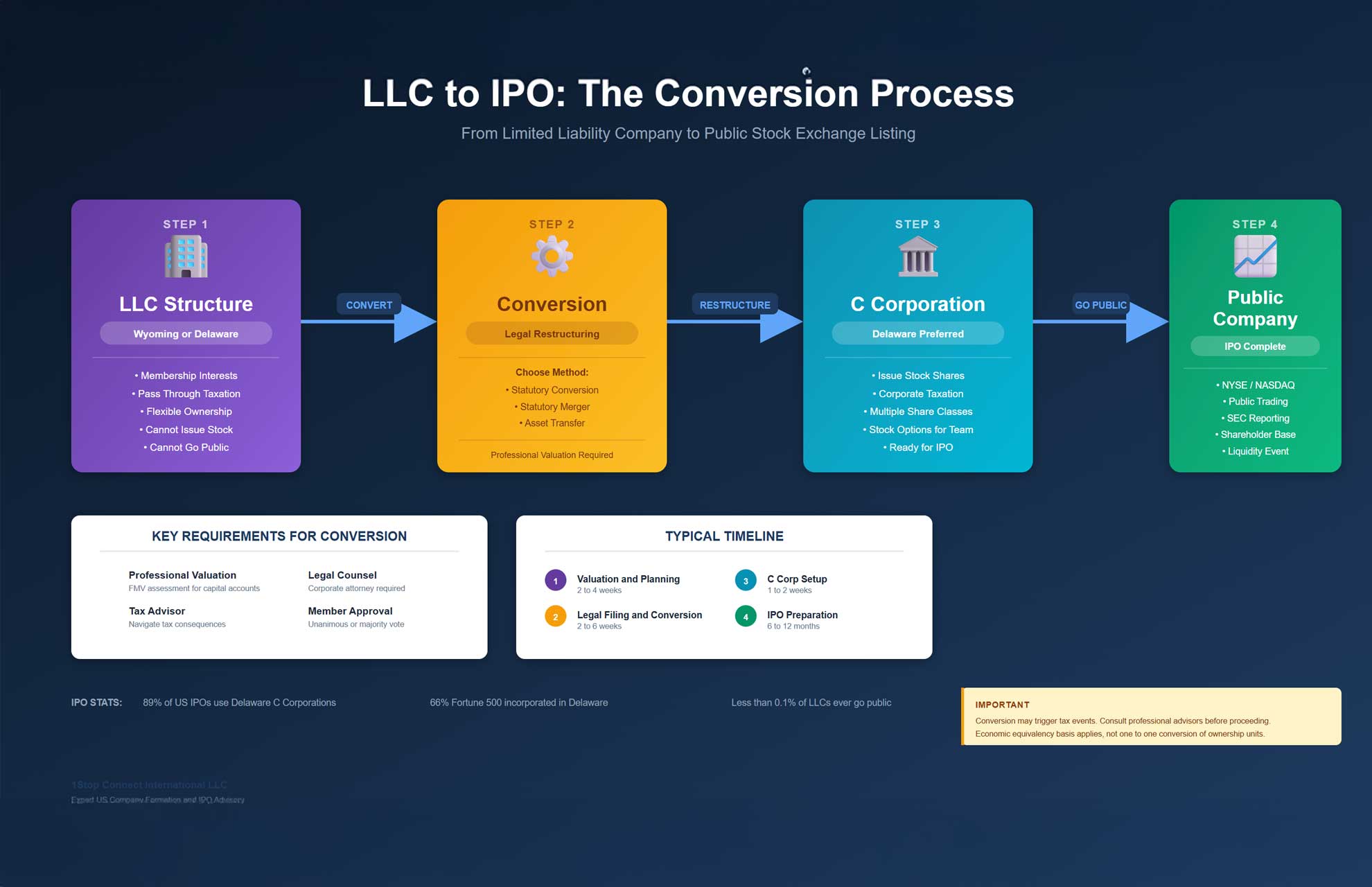
LLCs Cannot Go Public Directly
US stock exchanges like NYSE and NASDAQ do not list LLCs. To go public, you must be a C corporation.
This is because the Securities and Exchange Commission (SEC) requires companies offering shares to the public to have a corporate share structure. LLCs have membership interests, not stock shares.
So if your LLC wants to go public, you must first convert to a C corporation.
Conversion Process
There are three main ways to convert an LLC to a C corporation:
Statutory Conversion: Many states allow direct conversion. You file conversion documents with the Secretary of State. The LLC becomes a corporation. Same EIN, same assets, same liabilities. Only the legal structure changes.
Statutory Merger: You form a new corporation and merge the LLC into it. The LLC dissolves, the corporation survives. This achieves the same result as statutory conversion.
Asset Transfer: You form a new corporation and transfer LLC assets to it. The LLC may continue to exist or be dissolved. This is more complex and can trigger tax consequences.
All three methods require professional legal and tax advice. You need to value the LLC's assets at fair market value. You need to ensure the conversion is structured to minimize tax impact.
Nevada for IPO
Nevada is rarely used for IPO preparation. The state does not have the legal infrastructure or investor familiarity that Delaware provides.
If you form a Nevada LLC and later decide to go public, you would likely convert to a Delaware C corporation, not a Nevada corporation.
Nevada serves different purposes: privacy, asset protection, and cost effective operation for businesses that do not plan to raise institutional capital or go public.
Texas for IPO
Texas is emerging as a credible IPO state due to the Dexit movement. SpaceX reincorporating in Texas signals that major companies are comfortable with Texas as a domicile for significant operations.
If you form a Texas LLC and later want to raise venture capital or go public, you have options. You could convert to a Texas C corporation and pursue an IPO from Texas. Or you could convert to a Delaware C corporation to align with traditional investor expectations.
Texas is not yet the standard for IPOs. Delaware still dominates with 89% of US IPOs in 2019. But Texas is gaining credibility, particularly for companies that prioritize Texas business culture or want to avoid Delaware courts.
Most Venture Capital Requires Delaware
If you plan to raise institutional venture capital, most VCs expect a Delaware C corporation. They have standard investment documents designed for Delaware law. Their lawyers know Delaware case law.
You can start with a Nevada or Texas LLC to save costs and maintain privacy. When you are ready to raise Series A funding, you convert to a Delaware C corporation. Many startups follow this path.
Alternatively, if you are confident you will pursue venture capital within a year or two, you might form a Delaware C corporation from the beginning to avoid the conversion step later.
Decision Framework: Which State For You
Let me give you a practical framework for choosing between Nevada and Texas.
Choose Nevada If:
Privacy is your top priority. You want maximum anonymity. You do not want your name appearing in public records. You value the ability to use nominee managers for additional privacy layers.
You need strong asset protection. You are holding real estate, investment portfolios, or significant assets through the LLC. You want the strongest possible charging order protections against creditors.
You operate in gaming, hospitality, or entertainment. Nevada has specialized expertise and regulatory frameworks for these industries.
You value a specialized business court. You want disputes resolved by judges with corporate law training rather than general courts.
Annual fees are not a primary concern. The $350 annual cost is acceptable given the privacy and protection benefits.
You are a high net worth individual. Privacy and asset protection outweigh cost considerations.
Choose Texas If:
You want the absolute lowest costs. Zero annual fees. No ongoing state compliance costs. You pay $300 once and never pay Texas again.
You are bootstrapping a startup. Every dollar saved matters. You would rather invest in your business than pay state fees.
Privacy is not critical. You are comfortable with your name appearing on the Certificate of Formation. You do not need maximum anonymity.
You prefer simplicity. No annual reports. No annual filings. Form it and forget it (from a state compliance perspective).
You have Texas operations or customers. It makes sense to incorporate where you do business.
You identify with the Dexit trend. You prefer Texas business culture. You want to avoid Delaware. You see Texas as the future.
You may pursue venture capital or IPO later. Texas is gaining credibility. Investors increasingly accept Texas corporations. You have a path to institutional funding without necessarily converting to Delaware.
Consider Delaware Instead If:
If you plan to raise venture capital within 2 years or pursue an IPO within 5 years, consider Delaware despite higher costs. The investor familiarity and legal infrastructure may justify the expense.
Delaware is not part of this comparison article, but it remains the gold standard for venture backed startups and companies targeting public markets. We handle it in a seperate blog Delaware vs Wyoming
Consider Wyoming Instead If:
Wyoming offers privacy comparable to Nevada at costs even lower than Texas. $60 annual fee. Strong asset protection. If privacy is critical but you also want low costs, Wyoming deserves consideration.
Wyoming is not part of this comparison, but it is worth mentioning as an alternative that combines the best elements of both Nevada (privacy) and Texas (low cost). In a seperate blog you can read about the comparison Delaware vs Wyoming
For most international entrepreneurs forming their first US LLC, I recommend Texas. The cost savings are substantial. Privacy is sufficient for most legitimate businesses. You can always convert to Delaware later if you raise institutional capital. Start simple. Start cheap. Adjust as your business evolves.

How 1Stop Connect Helps
We have helped in many formations, LLCs for non residents in both Nevada and Texas. We understand the nuances.
Complete Formation Service
We handle everything. Name availability check and reservation. Preparation of Articles of Organization. Filing with the Nevada or Texas Secretary of State. Obtaining your EIN from the IRS, including for non residents without a social security number using Form SS-4.
We provide registered agent service in both states. Your company needs a physical address in the formation state. We provide this. We receive official mail and forward it to you.
We draft your operating agreement. Single member or multi member. Customized for your ownership structure and business needs.
Banking Assistance
Opening a US business bank account is challenging for non residents. We have relationships with Mercury, Relay, and Wise Business. We know their requirements. We prepare our clients properly.
We cannot guarantee bank approval because banks make their own decisions. But we significantly improve your chances by ensuring your documentation is correct and your business model is clearly explained.
Ongoing Compliance
For Nevada LLCs, we handle annual list filing and business license renewal. You do not need to track deadlines. We file on time every year.
For Texas LLCs, there is no annual state compliance. But we still provide ongoing support for federal tax filing, amendments to your operating agreement, and changes to your business structure.
State Changes and Conversions
If you start in Texas for cost savings and later need to convert to Delaware for venture capital, we handle the conversion. If you start in Nevada and later want to reincorporate in Texas, we manage the process.
Business needs evolve. The right state at formation may not be the right state five years later. We support you through these transitions.
Nominee Services
For clients who need maximum privacy, we provide nominee services in both Nevada and Texas. A nominee manager appears on public filings. You maintain actual control through the operating agreement.
This is legal and common. It is not about hiding illegal activity. It is about protecting privacy for legitimate business reasons.
Honest Advice
We do not push you toward the state that generates the most fees for us. We ask about your business goals, your growth plans, your privacy needs, and your budget. Then we recommend the state that actually fits.
Sometimes that is Nevada. Sometimes that is Texas. Sometimes it is Delaware or Wyoming. We care about getting it right for your situation.
This article provides educational information about Texas and Nevada company structures based on regulations as of October 2025. It is not legal advice. It is not tax advice. It is not a substitute for professional consultation.
Company formation laws, tax regulations, and substance requirements change. What is accurate today may change tomorrow. Licensing requirements vary by emirate and specific business activity. Banking policies change frequently.
Before forming any company structure, consult with licensed legal and tax professionals familiar with your specific situation. 1Stop Connect provides company formation services and can connect you with appropriate legal and tax advisors as needed.
The information here is accurate to our knowledge as of publication but carries no warranty. Laws change. Regulations evolve. Always verify current requirements before proceeding.
If you would like to discuss your specific situation, contact us directly. That is exactly what we are here for.