
The Two State Battle for Your Business
Every year, hundreds of thousands of entrepreneurs face the same critical decision: Delaware or Wyoming?
This is not a trivial choice. Where you incorporate your US LLC determines your annual costs, your privacy level, your legal protections, and ultimately your ability to raise capital and access public markets.
I have helped clients form companies in both states since 2018. I have seen businesses thrive in Wyoming. I have watched startups successfully raise millions after incorporating in Delaware. And I have seen companies make the wrong choice and pay for it.
"My Delaware counsel and I will have a wide ranging and sophisticated body of corporation law—a jurisprudence if you will—to bring to bear on almost any problem that will arise. No other jurisdiction can provide so much."
— Bayless Manning, Former Dean of Stanford Law School
The conventional wisdom says Delaware for venture backed startups, Wyoming for everyone else. But the reality in 2025 is more complex. The landscape is shifting.
This guide cuts through the noise. I will show you he real legal differences, and the practical implications for your specific situation. Whether you are a non resident looking to enter the US market or a domestic entrepreneur choosing your first state, this analysis will help you decide.
Let us examine the facts.
- Delaware vs Wyoming: The Core Differences
- Privacy Protections: Who Sees What
- Legal Framework: Courts and Precedents
- For Non Residents: What Actually Matters
- Real Companies: Who Chose What
- The Dexit Movement: Why Companies Are Leaving Delaware
- Route to Stock Market: IPO Conversion
- Decision Framework: Which State For You
- How 1Stop Connect Helps
- Final Thoughts: There Is No Universal Answer
Delaware vs Wyoming: The Core Differences
Before we dive into details, let me give you the foundational comparison. These are the facts that matter most.
Delaware: The Corporate Capital
Delaware is home to 67.8 percent of Fortune 500 companies. In 2019, 89 percent of US based initial public offerings incorporated in Delaware. This dominance is not accidental.
Delaware has the Court of Chancery, a specialized business court established in 1792. This court handles corporate disputes without juries. Judges, not lay people, decide cases. These judges are experts in corporate law. They have seen every type of business dispute imaginable.
The result is predictability. Delaware corporate law has over 200 years of case history. When you structure a transaction in Delaware, you can research how similar situations were resolved. Investors know this. Venture capitalists know this. That is why they prefer Delaware.
Delaware allows flexible corporate structures. You can issue multiple classes of stock. You can create complex governance arrangements. You can design employee stock option plans. The law supports these mechanisms.
But Delaware has downsides. It costs more. State income tax ranges from 2.2 to 6.6 percent on income earned in Delaware. And privacy is limited. Member names are publicly disclosed in formation documents.
Wyoming: The Privacy and Cost Leader
Wyoming created the LLC structure in 1977. It was the first state to do so. This gives Wyoming deep experience with LLC law.
In 2025, Wyoming had 378 new company formations per 1,000 adults. Delaware had 268 per 1,000 adults. On a per capita basis, Wyoming leads.
Wyoming offers anonymous ownership. Member and manager names do not appear on public filings. Only the registered agent name is visible. For entrepreneurs who value privacy, whether for personal safety or competitive reasons, Wyoming is unmatched.
Wyoming has the strongest LLC asset protection laws in the United States. For single member LLCs, Wyoming explicitly provides charging order protection. This means creditors can only claim distributions if you make them. They cannot seize business assets or force liquidation.
The cost structure favors Wyoming dramatically. There is no franchise tax. No state income tax. No capital gains tax. For online businesses with no physical Wyoming assets it is cheap.
Wyoming also offers simplified compliance. No operating agreement required (though recommended). No list of initial members. Less bureaucracy overall.
The tradeoff is investor perception. Venture capitalists, especially institutional funds, may hesitate with Wyoming entities. They are accustomed to Delaware. They trust Delaware law. Converting to Delaware later is possible, but it adds a step.
Privacy Protections: Who Sees What

Privacy is one of the biggest differences between these states. Let me explain what is actually private and what is public.
Wyoming Privacy
Wyoming does not require member or manager names in public filings. When you file Articles of Organization, you list the company name, registered agent, and registered office address. That is it.
Your name as owner does not appear. Your address does not appear. The names of any managers do not appear. This information is maintained internally by the company and provided to authorities if legally required, but it is not in the public record.
This creates real privacy. If someone searches the Wyoming Secretary of State database for your company, they will find the company name and registered agent. They will not find your name.
Wyoming also allows nominee services. You can use a nominee manager (a third party who serves as the public face) while you retain actual control through operating agreement provisions. This adds another privacy layer.
Delaware Privacy
Delaware requires more disclosure. Member names are not required on the Certificate of Formation, but if your LLC is member managed (which most are), the members' names and addresses appear in subsequent filings.
For manager managed LLCs, you can keep member names private and only disclose the manager. But this adds complexity and you need a manager willing to serve in that role.
Delaware privacy is workable but not as strong as Wyoming. You can maintain some anonymity with proper structuring, but it requires more effort.
Why Privacy Matters
Some people dismiss privacy as only mattering for "shady" businesses. This is wrong.
Legitimate privacy interests include: Personal safety for high profile individuals or those in sensitive situations. Competitive reasons when you do not want competitors knowing your business structure. Asset protection when you want to reduce your public exposure to potential litigants. Estate planning where privacy helps protect family wealth.
If privacy matters to you, Wyoming is the clear winner.
No US LLC provides complete anonymity. Beneficial ownership information must be disclosed to authorities under federal law. Banks will know who owns the company. The IRS will know. Privacy protections limit public disclosure, not government disclosure. If you are involved in illegal activity, privacy will not protect you.
Legal Framework: Courts and Precedents

This is where Delaware truly shines. And where Wyoming takes a different approach.
Delaware Court of Chancery
The Court of Chancery is Delaware's secret weapon. Established in 1792, it handles all corporate disputes. No juries. Only judges.
These judges are chosen for their business law expertise. They hear corporate cases day after day, year after year. They understand complex transactions. They know how businesses actually operate.
The result is fast, predictable rulings. Delaware business disputes are typically resolved in 6 to 12 months. In other states, similar cases drag on for 12 to 24 months or longer.
Delaware also has an enormous body of case law. Over 200 years of corporate disputes have been litigated and decided. This creates precedent. When you structure a transaction, you can find analogous cases and predict outcomes.
Investors love this. Venture capitalists know Delaware law. Their lawyers know Delaware law. When they review your corporate documents, they understand how Delaware courts would interpret provisions.
This matters most for complex situations. If you plan to have preferred stock, liquidation preferences, anti dilution provisions, or sophisticated governance structures, Delaware provides the legal certainty you need.
Wyoming Legal Environment
Wyoming takes a simpler approach. The state courts handle business disputes like any other case. There is no specialized business court.
But Wyoming has strong LLC statutes. The state pioneered the LLC in 1977 and has continuously refined its laws. Wyoming explicitly provides charging order protection for single member LLCs, something Delaware's law leaves ambiguous.
For most small to medium businesses, Wyoming's legal framework is perfectly adequate. If you are running an e-commerce store, a consulting practice, or a digital agency, you do not need the Court of Chancery. You need clear liability protection and reasonable asset protection laws. Wyoming delivers both.
The limitation is investor sophistication. If you plan to raise institutional venture capital, those investors expect Delaware. They have seen Delaware operating agreements thousands of times. They trust Delaware case law. A Wyoming LLC introduces unfamiliarity.
Asset Protection Advantage: Wyoming
Here is where Wyoming actually beats Delaware for many owners. Wyoming has the strongest LLC asset protection laws in the nation.
Specifically, Wyoming explicitly extends charging order protection to single member LLCs. This is huge. A charging order limits a creditor to receiving distributions if and when the LLC makes them. The creditor cannot force liquidation. Cannot seize assets. Cannot participate in management.
Delaware law is unclear on whether this protection applies to single member LLCs. Some Delaware cases suggest it does not. This creates risk.
If asset protection is a priority, and you have a single member LLC, Wyoming is stronger.
✓ Delaware Legal Strengths
- Court of Chancery with specialized business judges
- Over 200 years of corporate case law
- Predictable and fast dispute resolution
- Investor and VC familiarity and trust
- Supports complex governance structures
- Facilitates stock issuance and equity plans
- Preferred for eventual IPO or acquisition
✓ Wyoming Legal Strengths
- Strongest LLC asset protection in US
- Explicit charging order protection for single member
- Simplified statutes with less complexity
- Pioneered LLC structure in 1977
- Clear liability protections for members
- Fewer disclosure requirements overall
- Lower litigation costs for simple disputes
For Non Residents: What Actually Matters
I work primarily with non US residents forming US companies. Let me address your specific concerns.
Both States Allow Foreign Ownership
You do not need to be a US citizen or resident to form an LLC in either Delaware or Wyoming. Both states allow 100 percent foreign ownership. This is standard across the US.
You will need a registered agent with a physical address in the formation state. Both states require this. 1Stop Connect provides registered agent services in both states, so this is not a barrier.
EIN and Banking
Getting an Employer Identification Number (EIN) from the IRS is identical for both states. Non residents without a Social Security Number use Form SS-4, submitted by mail or fax. Processing takes 4 to 6 weeks typically.
Banking access is also identical. Whether you form in Delaware or Wyoming, US banks treat you the same. Mercury, Relay, and Wise Business all accept both Delaware and Wyoming LLCs. They care about your business model and documentation, not which state you chose.
Some people claim Delaware LLCs get better banking access. This is not true in 2025. Banks care about KYC (know your customer) compliance, business substance, and transaction patterns. The formation state is irrelevant.
Tax Treatment for Non Residents
Both states offer pass through taxation for LLCs. This means the LLC itself does not pay federal income tax. Income passes through to the members.
For non residents with no US source income, this often means no US tax liability. If you earn income from US sources, you will have US tax obligations regardless of which state you choose.
The state level difference is that Delaware charges $300 franchise tax annually. Wyoming charges $60 annual report fee. Both require filing if you have Delaware or Wyoming source income respectively. For most non residents operating internationally, neither state creates additional income tax (though Delaware's franchise tax still applies).
Ongoing Compliance
Delaware requires an annual franchise tax filing. Wyoming requires an annual report. Both are straightforward.
For federal compliance, you will file Form 1065 (partnership return) if your LLC has multiple members, or treat it as a disregarded entity on your personal tax return if you are the sole member. This is the same for both states.
Neither state is easier or harder for non residents from a compliance standpoint. The work is essentially identical.
So Which State for Non Residents?
If you are a non resident looking to enter the US market, here is my honest recommendation:
Choose Wyoming if: You want lowest ongoing costs. Privacy is important to you. You plan to bootstrap and grow organically. You are running a digital business with no physical US presence. You do not plan to raise US venture capital in the next 3 years.
Choose Delaware if: You plan to raise venture capital from US investors within 2 to 3 years. You want maximum investor familiarity. You are building a high growth startup targeting eventual exit or IPO. You operate in a complex regulatory environment where legal predictability matters.
For most non residents, Wyoming makes more sense initially. You can always reincorporate to Delaware later if your situation changes.
I have formed companies in both states for hundreds of non resident clients. The formation process is identical. The banking process is identical. The tax compliance is identical. The only differences that matter are cost, privacy, and investor expectations. Everything else is the same.
Real Companies: Who Chose What

Let me show you actual examples of companies and their incorporation choices.
Delaware Dominance: Fortune 500
Delaware hosts an incredible concentration of major corporations. Amazon. Google. Walmart. Coca Cola. Apple. Microsoft. Facebook (now Meta). The list goes on.
Over 1.5 million companies are incorporated in Delaware. The state has a population of approximately 995,000. Think about that. More companies than people.
As of November 2025, Delaware had approximately 5.6 million total business entities registered. This includes corporations, LLCs, limited partnerships, and other structures.
Why do these giants choose Delaware? Legal predictability. The Court of Chancery. Investor expectations. When you are managing a multibillion dollar corporation with complex governance, Delaware provides the legal infrastructure you need.
The Dexit Movement
But something changed in 2024 and 2025. High profile companies started leaving Delaware. This movement has been called Dexit (Delaware Exit).
- SpaceX: Reincorporated from Delaware to Texas in February 2024. Elon Musk announced the move on X (formerly Twitter), stating "SpaceX has moved its state of incorporation from Delaware to Texas."
- Tesla: Announced plans for shareholder vote to reincorporate in Texas. This followed a Delaware court ruling that invalidated Musk's $56 billion compensation package. As of late 2025, Tesla was still incorporated in Delaware but the vote is pending.
- Neuralink: Moved from Delaware to Nevada in early 2024. The brain computer interface company made the change shortly after being founded.
- X (formerly Twitter): Reincorporated in Nevada in April 2023 when Musk rebranded the platform after acquiring it.
- The Boring Company: Initially incorporated in Delaware as a Tesla subsidiary, then changed to Nevada in March 2023 after spinning off.
- Roblox and Dropbox: Both announced departures from Delaware or considerations to leave, joining the Dexit trend.
Why Are They Leaving?
The catalyst was a Delaware Court of Chancery ruling that struck down Elon Musk's Tesla compensation package. Musk argued the ruling showed Delaware courts were becoming unpredictable and politically motivated.
Other companies cited rising franchise fees, increasing litigation risk, and states like Texas, Nevada, and Wyoming offering lower costs with adequate legal protections.
Critics of Delaware point out that while the Court of Chancery provides expertise, it also enables aggressive shareholder litigation. Plaintiff lawyers can easily file suits. Some founders feel the balance has tilted too far toward shareholders and against management.
States like Texas have created specialized business courts to compete with Delaware. Nevada and Wyoming offer different value propositions: lower costs, stronger privacy, and less litigation exposure.
Delaware Still Dominates IPOs
Despite Dexit, Delaware remains the overwhelming choice for companies going public. In 2019, 89 percent of US based IPOs incorporated in Delaware.
This makes sense. When you go public, investors expect Delaware. Investment banks expect Delaware. The IPO process is smoother in Delaware because everyone involved has done it hundreds of times before.
So even companies that start elsewhere often reincorporate to Delaware before their IPO.
Wyoming Growth
Wyoming has seen massive growth in LLC formations. From 880,000 entities in November 2023 to 1.25 million in November 2025. That is 370,000 new entities in 2 years.
On a per capita basis, Wyoming now leads Delaware: 378 new formations per 1,000 adults versus Delaware's 268 per 1,000 adults.
This growth is driven by small businesses, digital entrepreneurs, e-commerce sellers, and privacy conscious individuals. These are not Fortune 500 companies. They are LLCs that value low cost and anonymity.
The Dexit Movement: Why Companies Are Leaving Delaware
Let me explain what is actually happening with Dexit and what it means for you.
The Musk Catalyst
In January 2024, Delaware Chancellor Kathaleen McCormick struck down Elon Musk's $56 billion Tesla compensation package. She ruled that the package was excessive and that Tesla shareholders were not adequately informed.
Musk responded aggressively. He posted on X: "Never incorporate your company in the state of Delaware. I recommend incorporating in Nevada or Texas if you prefer shareholders to decide matters."
He moved SpaceX to Texas immediately. He called for Tesla shareholders to vote on reincorporating in Texas. He moved Neuralink to Nevada.
This was not just one disgruntled CEO. Musk has massive influence in the tech and business community. His public criticism of Delaware resonated with other founders who had similar frustrations.
Rising Costs and Litigation
Delaware's franchise tax has steadily increased. For corporations, the fees can reach tens of thousands or even hundreds of thousands of dollars for large companies.
Litigation in Delaware has also increased. The Court of Chancery, while expert and efficient, is accessible to plaintiffs. Shareholder suits are common. Some argue too common.
Delaware has developed a plaintiffs' bar that specializes in corporate litigation. These lawyers are skilled at finding grounds to challenge board decisions, compensation packages, and merger transactions.
For some companies, the legal environment feels hostile to management and boards. They prefer states where litigation risk is lower.
Competing States Are Getting Serious
Texas passed legislation creating specialized business courts to compete with Delaware's Chancery Court. These courts are designed to handle complex corporate cases efficiently.
Nevada has long positioned itself as a Delaware alternative, offering strong privacy protections and no state income tax. We have a comparison blog for Nevada vs Texas where you can read more.
Wyoming continues to refine its LLC statutes to attract formations.
These states are not just marketing. They are building actual legal infrastructure to support business.
Is Delaware Dying?
No. Delaware is not dying. Total Delaware incorporations continue to grow in absolute terms. From 5.02 million entities in November 2023 to 5.62 million in November 2025.
The real story is that Delaware's dominance is being challenged, particularly for small and mid sized companies. For Fortune 500 corporations and companies planning IPOs, Delaware remains the default.
But for LLCs, startups in early stages, and privacy focused businesses, alternatives like Wyoming, Nevada, and Texas are gaining traction.
What This Means For You
Dexit shows that Delaware is not untouchable. You have real alternatives. Wyoming, Nevada, and Texas offer legitimate business friendly environments.
If you are forming an LLC today, you do not need to default to Delaware just because "that is what everyone does." Evaluate your specific needs. Consider costs, privacy, investor expectations, and growth plans.
Delaware still makes sense for many businesses. But it is not the only option. And for many entrepreneurs, it is not the best option.
While high profile companies have left Delaware, most businesses are not leaving. Delaware continues to grow in absolute numbers. Dexit is a trend among certain types of companies (tech giants, founder controlled businesses) frustrated with specific Delaware policies. For most businesses, Delaware remains perfectly viable. The question is whether it is the best choice for your specific situation.
Route to Stock Market: IPO Conversion
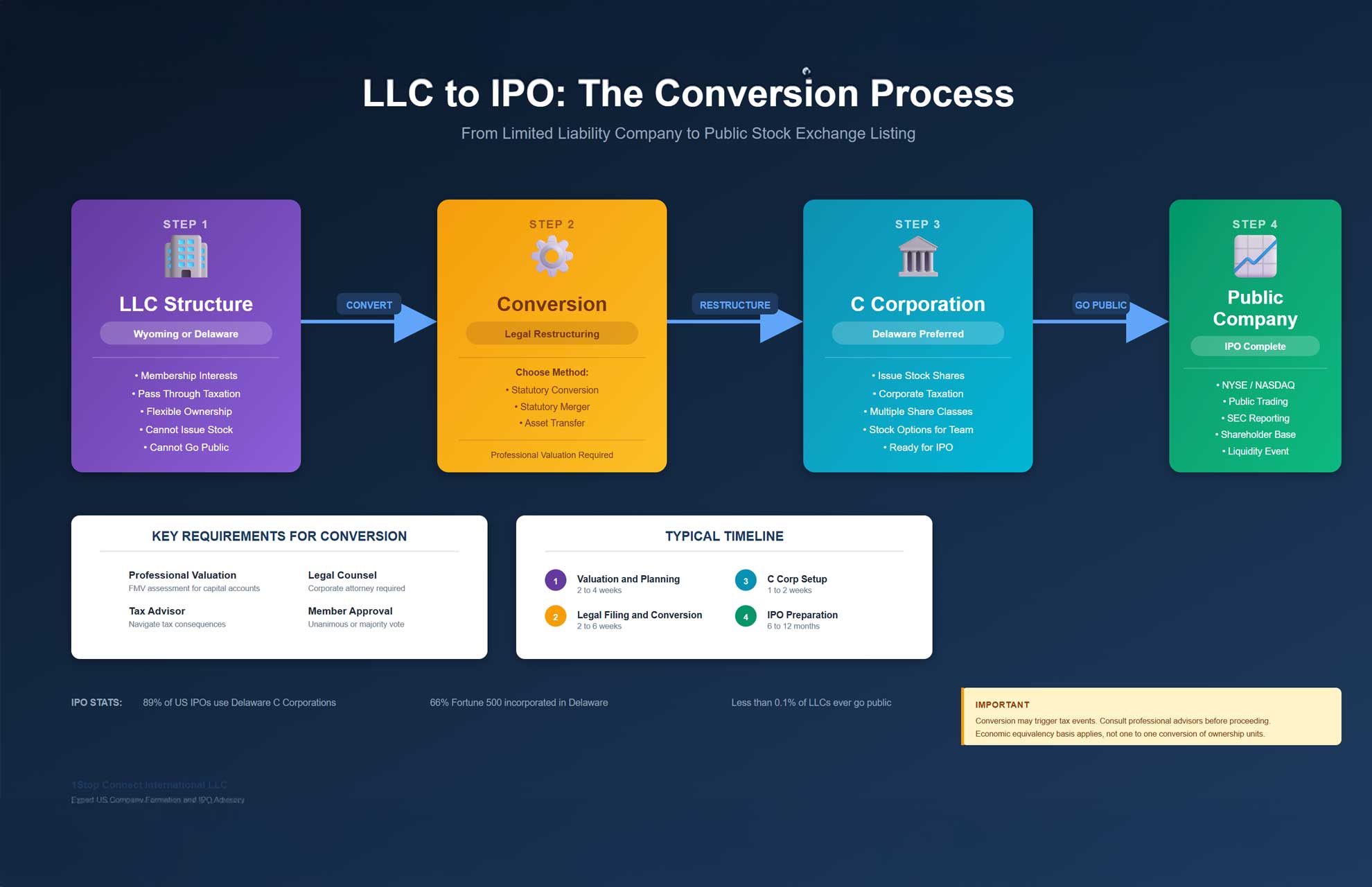
Many entrepreneurs ask: Can my LLC go public? The answer requires understanding the conversion process.
LLCs Cannot Directly IPO
US stock exchanges (NYSE, NASDAQ) do not list LLCs. To go public, you must be a corporation. Specifically, a C corporation.
This is because the Securities and Exchange Commission (SEC) requires companies offering shares to the public to have a corporate share structure. LLCs have membership interests, not stock. These membership interests do not meet SEC requirements.
So if your LLC wants to go public, you must first convert to a C corporation.
Conversion Methods
There are three main ways to convert an LLC to a C corporation:
Statutory Conversion: Many states allow a streamlined conversion where the LLC transforms directly into a corporation without dissolving. You file conversion documents with the Secretary of State. The business continues with the same EIN, same assets, same liabilities. Only the legal structure changes.
Statutory Merger: You form a new corporation, then merge the LLC into it. The LLC disappears, the corporation survives. This is slightly more complex but accomplishes the same result.
Asset Transfer: You form a new corporation, transfer all LLC assets to it, then dissolve the LLC. This is the most complex method and can trigger tax consequences.
Most businesses use statutory conversion or statutory merger. These are cleaner and have fewer tax issues if structured properly.
Economic Equivalency, Not One to One
Here is a critical point many people miss. LLC membership interests do not convert on a one to one basis to corporate stock.
Instead, conversion happens on an economic equivalency basis. This means you receive stock in the corporation that has equivalent value to your LLC membership interest.
To determine this, you must book up the LLC's capital accounts to fair market value immediately before conversion. This requires a professional valuation.
For example, if the LLC is worth $10 million and you own 30 percent of the LLC, you will receive stock representing 30 percent of a $10 million corporation. But the number of shares is determined by the valuation, not by your prior LLC ownership percentage.
Tax Implications
Conversion can trigger tax events. If the LLC has appreciated assets, transferring them to a corporation may result in gain recognition.
Under IRC Section 351, if you transfer property to a corporation in exchange for stock and immediately after the transfer you control the corporation (owning 80 percent or more), no gain is recognized. But this requires careful structuring.
You should work with a tax advisor who specializes in entity conversions. The tax consequences depend on your specific situation, asset values, and timing.
Delaware Advantage for IPO
This is where Delaware truly shines. When you convert to a C corporation for IPO purposes, investors, underwriters, and advisors expect Delaware.
66 percent of Fortune 500 companies are Delaware C corporations. 89 percent of US IPOs in 2019 were Delaware entities. There is a reason for this.
Investment banks know how to take Delaware corporations public. They have done it thousands of times. The legal work is standardized. Investors trust Delaware law.
If you incorporate a C corporation in Wyoming or Nevada and then try to go public, you will likely be told to reincorporate in Delaware first. This adds time, cost, and complexity.
The Smart Path for IPO Seekers
If you plan to go public within 5 to 7 years, here is the optimal structure:
Option 1: Start as a Delaware LLC, operate for early years, then convert to Delaware C corporation when raising Series A or preparing for IPO.
Option 2: Start as Wyoming LLC for cost savings, operate lean, then reincorporate to Delaware C corporation when you raise institutional capital.
Option 3: Start directly as a Delaware C corporation if you know from day one you are building for venture capital and IPO.
Most venture backed companies choose Option 3. They incorporate as Delaware C corporations from the beginning. This avoids conversion complexity and aligns with investor expectations immediately.
Bootstrapped companies often choose Option 2. Save money in Wyoming, build the business, then convert to Delaware when growth and capital raising justify it.
Fewer than 0.1 percent of US LLCs ever go public. If you are genuinely building for IPO, you likely know it from the beginning. Sophisticated founders targeting venture capital and eventual public listing almost always start as Delaware C corporations. If you are unsure whether you will go public, start with the structure that makes sense for your current situation. You can always convert later.
Decision Framework: Which State For You
Let me give you a practical framework for making this decision.
Choose Wyoming If
You want the lowest annual costs and fees. Privacy is important to you and you want anonymous ownership. You are building a small to medium business with no immediate venture capital plans. You operate a digital business (e-commerce, SaaS, consulting, content creation). You value asset protection and want the strongest LLC protection laws. You plan to bootstrap and grow organically. You are a solopreneur or have a small team. You do not need complex governance or multiple stock classes.
Choose Delaware If
You plan to raise venture capital within 2 to 3 years. You are building a high growth startup targeting eventual exit or IPO. Investor familiarity and trust matter more than cost savings. You need complex corporate structures (preferred stock, multiple classes, liquidation preferences). You operate in a highly regulated industry where legal predictability is critical. You want access to the Court of Chancery for potential disputes. You can afford the higher annual fees ($300 vs $60). You value the prestige and credibility Delaware provides to institutional investors.
When to Reincorporate
Many companies start in Wyoming and later reincorporate to Delaware. This typically happens at one of these milestones:
Raising Series A funding from institutional venture capital. Preparing for acquisition by a larger company. Planning for eventual IPO within 3 to 5 years. Adding sophisticated investors who require Delaware. Implementing complex equity compensation plans.
Reincorporation is straightforward. You file in the new state, merge or convert the entity, update your banking and tax registrations, and notify stakeholders. The process takes a few weeks.
Starting in Wyoming saves you money in early years when cash is tight. Converting to Delaware later aligns you with investor expectations when it matters.
Common Mistake: Choosing Delaware by Default
Many entrepreneurs choose Delaware simply because "that is what everyone does" or "it seems more professional."
This is a mistake if you are not actually pursuing the path that makes Delaware valuable. If you are bootstrapping a small business, Wyoming saves you money with no downside.
Do not pay for Delaware's benefits if you are not using them.
Common Mistake: Choosing Wyoming for Wrong Reasons
Some founders choose Wyoming because they read that it offers "better asset protection" or "more privacy" without understanding the context.
If you plan to raise venture capital, those investors will likely require you to reincorporate in Delaware anyway. Choosing Wyoming initially just adds a step.
Wyoming makes sense when your business model and growth strategy align with its advantages. Not because you read a blog post saying it is "the best state for LLCs."
The right choice depends on your actual situation. Not your aspirations. Not what you hope might happen someday. Your actual plan for the next 2 to 3 years. If you honestly plan to raise institutional venture capital, choose Delaware. If you honestly plan to bootstrap and build, choose Wyoming. If you are unsure, Wyoming provides more flexibility and lower cost while you figure it out.
How 1Stop Connect Helps
We form companies in both Delaware and Wyoming for clients worldwide. Here is how we help.
Complete Formation Service
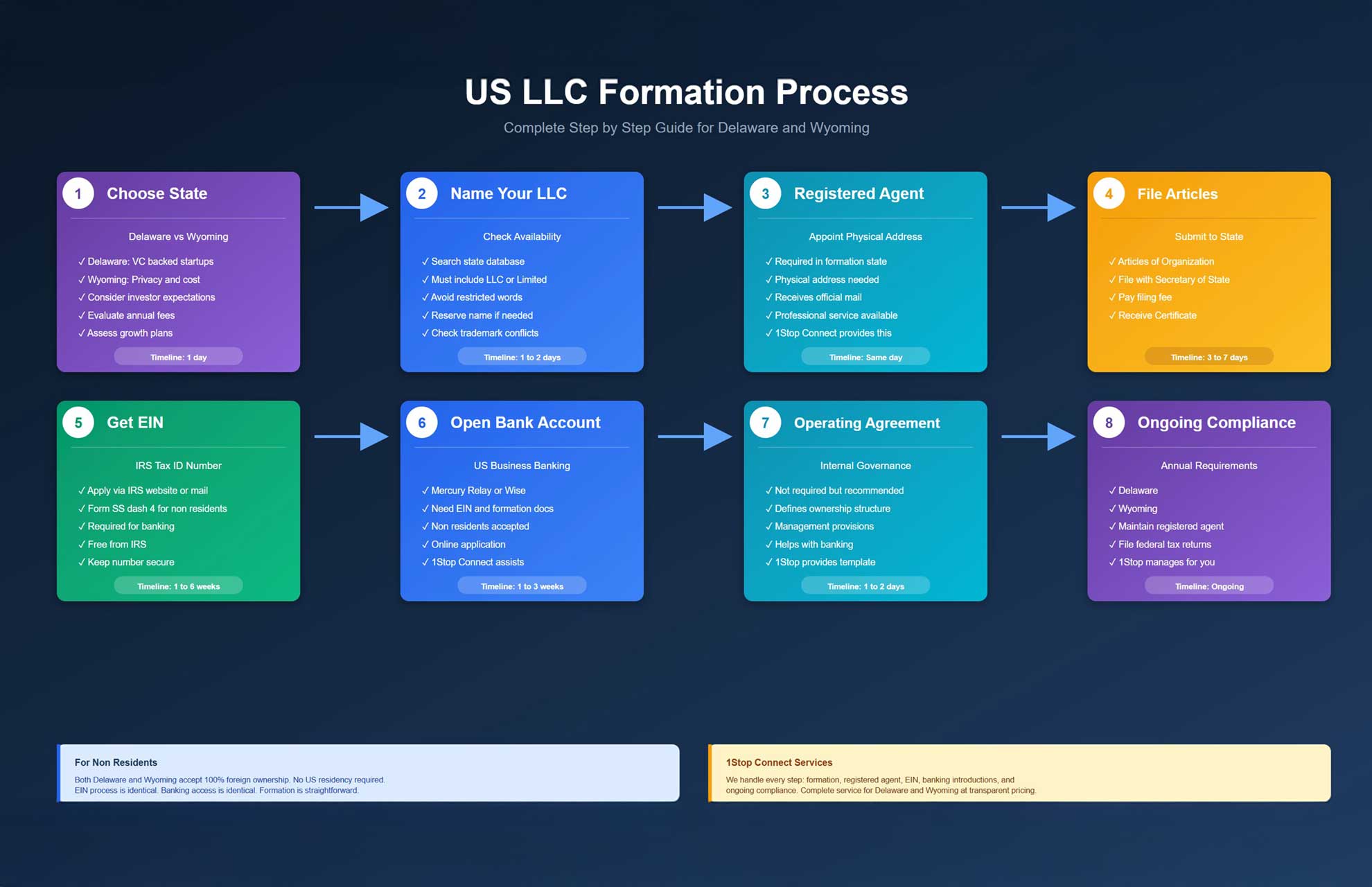
We handle the entire process. Name availability check and reservation. Preparation of Articles of Organization. Filing with Secretary of State. Obtaining EIN from the IRS (including for non residents without SSN). Drafting customized operating agreement. Setting up registered agent service.
For non residents, we navigate the additional requirements. EIN application via Form SS-4. Providing US address for business purposes. Assisting with banking introductions. Explaining US tax compliance obligations.
Registered Agent in Both States
Every LLC needs a registered agent with a physical address in the formation state. We serve as registered agent in both Delaware and Wyoming.
We receive official correspondence on your behalf. We forward it to you promptly. We ensure you never miss important deadlines or legal notices.
Honest State Recommendation
We do not push Delaware or Wyoming based on what earns us higher fees. We ask about your business model, growth plans, funding strategy, and privacy needs. Then we recommend the state that makes sense.
Sometimes we tell clients Delaware is unnecessary and Wyoming will save them money. Sometimes we tell clients Wyoming will create problems when they try to raise capital and Delaware is worth the cost.
Our goal is to set you up correctly from the beginning.
Banking Introductions
Opening a US business bank account is challenging for non residents. We have relationships with Mercury, Relay, and Wise Business. We know their requirements. We prepare clients properly.
We cannot guarantee account approval (that is always the bank's decision), but we maximize your chances by ensuring documentation is complete and accurate.
Reincorporation Support
If you start in Wyoming and later need to move to Delaware, we handle the transition. We prepare the conversion or merger documents. We file in both states. We update your EIN and tax registrations. We coordinate with your existing registered agent services.
This ensures the reincorporation is clean and compliant.
Ongoing Compliance
We manage annual report filings in Wyoming and franchise tax filings in Delaware. We ensure deadlines are met. We track changes to state requirements and notify you of any updates.
For federal compliance, we can introduce you to qualified CPAs who specialize in international tax for non resident LLC owners.
Transparent Pricing
Our formation fees are the same for Delaware and Wyoming. We do not charge more for Delaware just because we can.
You pay for formation services, registered agent, and operating agreement. No hidden fees. No surprise charges. You know the total cost before you commit.
Ready to form your US LLC? Contact 1Stop Connect for a free consultation. We will discuss your specific situation, recommend the right state, and guide you through the complete formation process. Whether Delaware or Wyoming is right for you, we make the process simple and transparent.
Final Thoughts: There Is No Universal Answer
Delaware and Wyoming both offer legitimate advantages. Neither is universally better.
Delaware wins for venture backed startups, companies planning IPOs, and businesses needing sophisticated legal frameworks. The Court of Chancery, extensive case law, and investor familiarity justify the higher costs for these use cases.
Wyoming wins for bootstrapped businesses, privacy conscious entrepreneurs, small LLCs, and digital operations with no physical US presence. Lower costs, anonymous ownership, and strong asset protection make it ideal for these situations.
The Dexit movement shows that Delaware is not untouchable. Major companies are leaving. Wyoming and other states are building credible alternatives.
But Delaware remains dominant for public companies and venture backed startups. This will not change overnight.
Your choice should reflect your actual business path, not theoretical possibilities. If you are genuinely building for venture capital and IPO, Delaware makes sense from day one. If you are building a profitable small business, Wyoming saves money with no meaningful downside.
And remember, you can always change states later. Many successful companies start in Wyoming for cost savings, then reincorporate to Delaware when raising institutional capital.
The important thing is to make an informed decision based on facts, not assumptions. Both states work. Choose the one that aligns with your goals.
If you need help making this decision or forming your LLC, 1Stop Connect is here. We form companies in both states. We give honest recommendations. And we handle the complete process so you can focus on building your business.
Let us help you get started.
This article provides educational information about Delware and Wyoming company structures based on regulations as of September 2025. It is not legal advice. It is not tax advice. It is not a substitute for professional consultation.
Company formation laws, tax regulations, and substance requirements change. What is accurate today may change tomorrow. Licensing requirements vary by emirate and specific business activity. Banking policies change frequently.
Before forming any company structure, consult with licensed legal and tax professionals familiar with your specific situation. 1Stop Connect provides company formation services and can connect you with appropriate legal and tax advisors as needed.
The information here is accurate to our knowledge as of publication but carries no warranty. Laws change. Regulations evolve. Always verify current requirements before proceeding.
If you would like to discuss your specific situation, contact us directly. That is exactly what we are here for.