
You want to sell products online, you want to know where to incorporate your e-commerce business? Then you have found the right BLOG. Here you can learn what is to consider, and what are your options.
I have helped hundreds of online sellers choose the right jurisdiction. Amazon FBA sellers, Shopify store owners, dropshippers from China. Each business model needs different consideration.
The wrong jurisdiction creates problems in many ways, payment processors reject you and your clients are frusttraded because of dealays in delivery, tax becomes complicated, banks refuse accounts. Suppliers do not trust your company.
The right jurisdiction makes everything easier. Payments flow smoothly. Taxes are optimized. Banking works. Suppliers accept your orders.
Let me show you the best jurisdictions for each e-commerce model in 2025.
Amazon FBA Sellers: Where to Incorporate
Amazon FBA is the most popular e-commerce model. You send inventory to Amazon warehouses. Amazon handles storage, packing, and shipping.
Your jurisdiction choice affects taxes, payment processing, and operational simplicity.
US LLC: The Default Choice
Most Amazon FBA sellers choose a US LLC. This makes sense if selling on Amazon US marketplace.
Benefits of US LLC for Amazon FBA:
Amazon Marketplace Access: Amazon prefers US registered businesses for the US marketplace. You can sell without a US company, but it creates friction. Amazon may hold payments longer. You face more verification requirements.
Payment Processing: US companies get paid faster and with fewer holds. Stripe and PayPal work seamlessly with US entities.
US Business Bank Account: Mercury, Relay, and Wise readily open accounts for US LLCs owned by non residents. This gives you a US bank account for receiving Amazon payments.
Supplier Trust: US suppliers and manufacturers take you seriously with a US company. They extend better payment terms and pricing.
Tax Treatment: Here is the key point. If you are a non US person and own a US LLC, you pay zero US federal income tax on income from selling physical products. The LLC is a disregarded entity for US tax purposes. Your profit is not US source income if you have no US employees or offices.
You do have state sales tax obligations. If your inventory sits in California Amazon warehouses, you have California sales tax nexus. Amazon handles marketplace facilitator tax in most states, but you still need to register.
Which US State for Amazon FBA?
Wyoming: Cheapest option, formation costs are low, annual fee are flat, no state income tax, is is simple and affordable. Best for bootstrapped sellers.
Delaware: Traditional choice, maybe consider it higher on annual fees, but better if you plan to raise funding or go public eventually, investors recognize Delaware.
Texas: Zero ongoing fees after formation. Good option if you want to minimize costs. No annual report requirement.
For most Amazon FBA sellers, Wyoming or Texas makes the most sense. Delaware is overkill unless you have specific reasons.
UK LTD for European Sellers
If you sell primarily on Amazon UK and Amazon EU marketplaces, consider a UK limited company.
Benefits: Easy formation (can be done online in one day). Low cost (around £12 annual filing fee). UK business bank account accessible. VAT registration straightforward. Amazon UK prefers UK companies.
Tax: UK corporation tax is 25% on profits over £50,000. You must have substance (real office, employees, or director residing in UK) or face challenges.
Many non resident sellers use a UK LTD with a UK director service. This provides the substance needed.
Hong Kong or Singapore for Asian Sellers
If you source from Asia and sell globally, Hong Kong or Singapore companies work well.
Hong Kong: Territorial taxation means offshore trading (buy from China, sell to US/EU customers) is tax exempt. Formation costs around $1,500. Annual compliance approximately $1,500. Excellent banking. Strong reputation.
Singapore: Similar territorial concept. Corporate tax is 17%, but extensive tax incentives exist. Better than Hong Kong if you need to demonstrate substance for customers or suppliers.
Both jurisdictions require a personal visit for bank account opening in most cases.
Selling on Amazon US? Form a Wyoming or Texas LLC. Zero federal tax for non residents. Easy payment processing. Low cost. Simple compliance.
Selling on Amazon UK/EU? Form a UK LTD or use your home country company if in the EU. VAT registration required regardless.
Selling globally with Asian sourcing? Consider Hong Kong company for tax efficiency and supplier credibility.
Shopify Businesses: Tax Optimization
Shopify gives you more flexibility than Amazon. You control your website and customer relationships. You are not locked into one marketplace.
This flexibility extends to jurisdiction choice. Shopify Payments accepts companies from many countries. You have more options than Amazon FBA sellers.
US LLC for Shopify Stores
A US LLC works excellently for Shopify businesses, especially if most customers are in the United States.
Advantages: US LLC provides credibility with US customers. Your business address appears professional. Payment processors like Stripe and PayPal prefer US entities and offer better rates.
Tax: Same as Amazon FBA. Non resident owners pay zero US federal income tax on online sales. You have sales tax obligations in states where you have nexus (physical presence or meet economic nexus thresholds).
Shopify Payments: Works seamlessly with US LLC. Lower transaction fees compared to third party gateways.
Estonia e-Residency for Digital Nomads
Estonia offers e-Residency, allowing you to form and manage an Estonian company entirely online. This is popular among digital nomads and EU focused sellers.
Formation: Apply for e-Residency (costs around €100 for the card). Form an OU (Estonian private limited company) online. Costs approximately €190 annually.
Banking: LHV Bank in Estonia or Wise business account works for e-residents. You never need to visit Estonia.
Tax: Estonia has a unique system. Corporate tax is 20%, but it is only paid when you distribute profits. If you reinvest in the business, you defer tax indefinitely. This makes Estonia attractive for growing Shopify stores.
EU Access: Estonian company gives you EU VAT registration and SEPA banking. Good if your customers are primarily European.
Downsides: Estonian bank accounts face some restrictions with certain payment processors. Compliance requires annual reports and accounting. Not the simplest option, but good for serious EU focused businesses.
UAE Freezone for Middle East Sellers
If you sell in the Middle East or want a zero tax jurisdiction with good banking, UAE freezone companies work.
Zero Corporate Tax: UAE freezone companies pay 0% corporate tax on qualifying activities (until recent changes for large companies, but most Shopify stores still qualify for 0%).
Residency: UAE company gives you a residence visa. Useful if you want to live in Dubai while running your business.
Banking: UAE banks work with freezone companies. You can open accounts with Emirates NBD, Mashreq, or others.
Limitations: Some payment processors are hesitant about UAE companies. Stripe does not operate in UAE (though you can use Stripe Atlas to form a US entity). PayPal works but may hold funds more aggressively.
Home Country Company
Do not overlook the simplicity of using your home country company structure.
If you live in a country with reasonable corporate tax rates and good international banking, forming a local company may be the easiest option. You understand the legal system, speak the language, and have local accountants and lawyers.
When it makes sense: You are just starting and testing products. Your revenue is under $100,000. You want to minimize complexity. Your home country has decent tax treaties.
When to look elsewhere: Your home country has high corporate tax (over 25%). Banking is difficult or expensive. You plan to scale significantly and want to optimize from the start.
US customers primarily? US LLC (Wyoming or Delaware) for credibility and payment processing.
EU customers primarily? Estonia OU for tax deferral and EU access, or UK LTD for simplicity.
Digital nomad or Middle East focus? UAE freezone for 0% tax and residency options.
Just starting with under $50K revenue? Use your home country company until you prove the business model.
Dropshipping: Best Structures
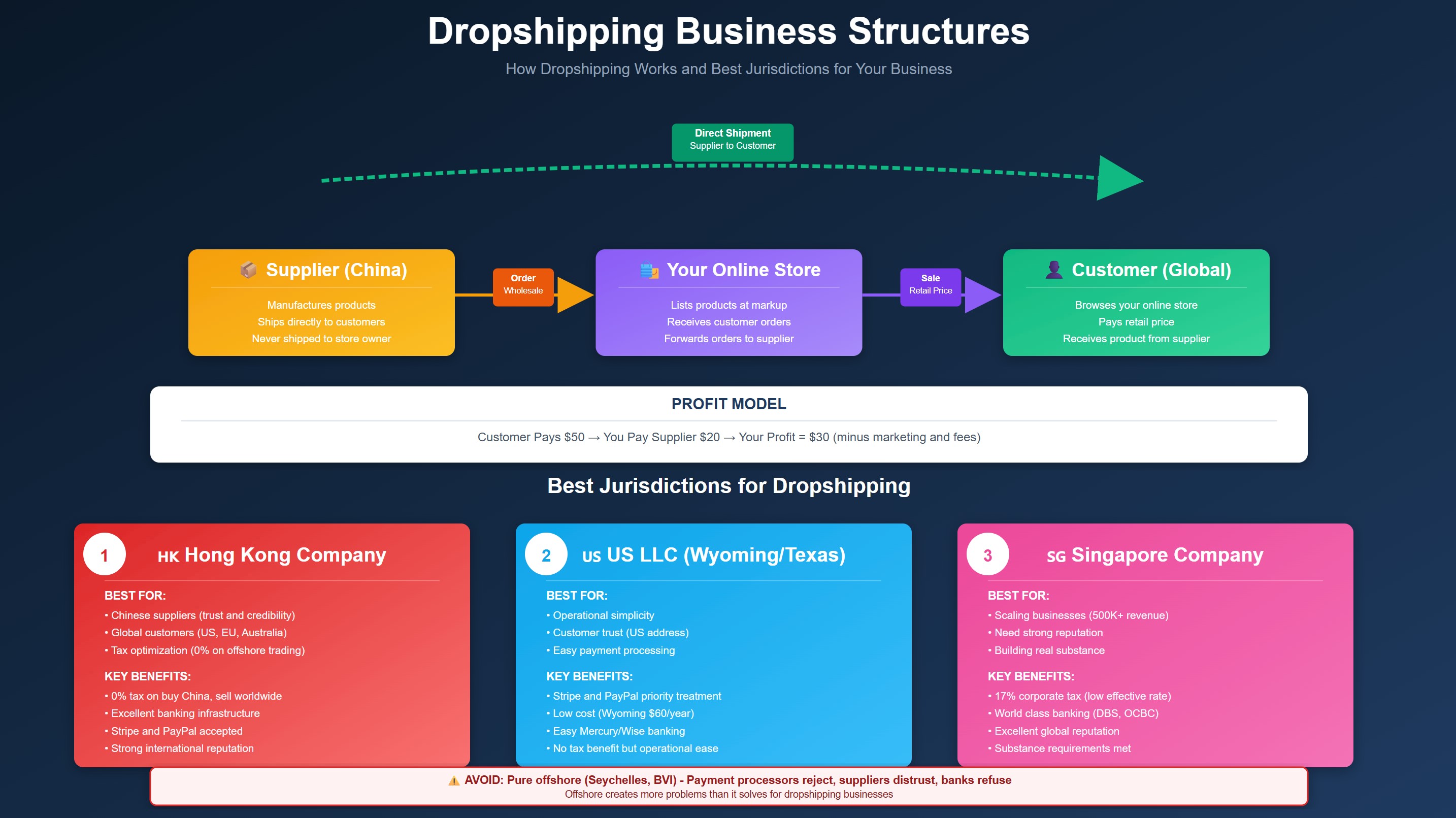
Dropshipping has the lightest requirements of all e-commerce models. You never touch inventory. You forward orders to suppliers who ship directly to customers.
This operational simplicity gives you more jurisdiction options. You can run dropshipping from almost anywhere with just a laptop and internet.
Hong Kong: The Dropshipping Favorite
Hong Kong is popular among dropshippers, especially those sourcing from China and selling globally.
Tax Benefits: Hong Kong uses territorial taxation. If you buy from Chinese suppliers and sell to customers outside Hong Kong (US, Europe, Australia), this is offshore trading. Result: 0% Hong Kong tax on profits.
Banking: Hong Kong has excellent banking infrastructure. HSBC, Standard Chartered, and local banks provide business accounts with multi currency capabilities. You need to visit Hong Kong to open accounts in most cases.
Supplier Relationships: Chinese suppliers trust Hong Kong companies. They see Hong Kong as legitimate and professional. Better than a US LLC to them, and far better than offshore companies like Seychelles.
Payment Processors: Stripe works in Hong Kong. PayPal accepts Hong Kong companies. Most payment gateways are accessible.
Costs: Formation around $1,500. Annual compliance (audit, secretary, registered address) approximately $1,500 to $2,500. More expensive than a US LLC but worth it for the tax benefits if you have substantial profit.
US LLC Despite No Tax Advantage
Many dropshippers still choose US LLCs even though there is no US tax benefit for non residents.
Why? Supplier and customer perception. A US company looks more legitimate to suppliers (even Chinese ones) than an offshore company. Customers buying from your Shopify store trust a US business address more.
Payment Processing: Easier than with offshore jurisdictions. Stripe and PayPal treat US companies better with fewer holds and reviews.
Downsides: You pay income tax in your country of residence anyway (most countries tax worldwide income). The US LLC provides no tax savings. It is purely operational convenience.
Singapore for Scaling Dropshippers
If your dropshipping business is doing serious revenue (over $500,000 annually), Singapore becomes attractive.
Tax: 17% corporate tax, but the first SGD 200,000 of profit is taxed at lower effective rates (around 8.5% average due to exemptions). If you can demonstrate that profits are from offshore trading, you may argue for exemption.
Reputation: Singapore company carries weight. Suppliers, payment processors, and customers all view Singapore as stable and trustworthy.
Banking: World class banking. DBS, OCBC, UOB provide excellent international banking services.
Substance: You need real substance. Singapore requires you to have a local director or employment pass. Nominee director services exist but are heavily scrutinized.
What About Pure Offshore (Seychelles, BVI, etc.)?
Some dropshippers consider pure offshore jurisdictions like Seychelles, BVI, or Belize because they offer zero tax and easy formation.
Do not do this for dropshipping. Here is why:
Payment Processors Reject You: Stripe does not work with Seychelles companies. PayPal will hold your funds or close your account. Most legitimate payment gateways refuse or heavily restrict offshore companies.
Suppliers Do Not Trust You: Chinese suppliers are wary of pure offshore companies. They see them as scams or money laundering fronts. They will require full prepayment instead of extending any credit terms.
Banking Is Difficult: Opening a real bank account for a Seychelles company is nearly impossible. You end up using second tier payment processors with high fees and frequent account freezes.
Your Residence Country Sees Through It: Most countries with proper tax enforcement will consider your offshore company a sham and tax you on the profits anyway. You get all the downsides with none of the benefits.
1. Hong Kong - Best for Chinese suppliers, 0% tax on offshore trading, excellent banking.
2. US LLC - Best for operational simplicity, customer trust, payment processing (despite no tax benefit).
3. Singapore - Best for scaling businesses with substance, strong reputation.
4. Home Country - Acceptable for starting out or if your country has reasonable tax rates.
5. Pure Offshore - Do not use. Creates more problems than it solves.
Payment Processor Friendly Jurisdictions
Your jurisdiction choice directly affects which payment processors accept you. This is often more important than tax optimization for online businesses.
If you cannot process payments, you cannot make sales. Choose a jurisdiction that payment processors trust.
Stripe Accepted Countries
Stripe is the gold standard for online payments. It offers the best rates, the smoothest integration, and the most features.
Stripe operates in: United States, Canada, United Kingdom, Australia, Singapore, Hong Kong, most of the EU, Japan, and a few others.
If your company is incorporated in one of these countries, you can get a Stripe account relatively easily.
Best jurisdictions for Stripe: US LLC, UK LTD, Singapore company, Hong Kong company, Estonian OU, Irish company.
Difficult or impossible: UAE companies (Stripe does not operate in UAE), pure offshore companies (Seychelles, BVI, Belize), most African and South American countries.
PayPal Business Accounts
PayPal is more flexible than Stripe in terms of accepted countries. Almost every country has PayPal. But PayPal treats different jurisdictions very differently.
PayPal trusts: US, UK, EU, Canada, Australia, Singapore, Hong Kong. These get normal processing with standard holds.
PayPal is cautious with: Newer or less established companies from emerging markets. Expect longer payment holds (21 days is common), reserve requirements, and more scrutiny.
PayPal heavily restricts: Pure offshore jurisdictions. If your company is in Seychelles or BVI, expect holds, sudden account limitations, or outright rejections.
Shopify Payments
Shopify Payments (powered by Stripe) is available in select countries. If you can use it, it offers the best rates because there are no transaction fees (just credit card processing fees).
Available in: United States, Canada, United Kingdom, Ireland, Australia, New Zealand, Austria, Belgium, Denmark, Germany, Spain, Finland, France, Italy, Netherlands, Portugal, Singapore, Sweden, Czech Republic, Japan.
If your company is not in one of these countries, you must use third party payment gateways which charge higher transaction fees.
Alternative Payment Processors
2Checkout (now Verifone): Accepts companies from almost any country. Good backup if Stripe and PayPal reject you. Higher fees (around 3.5% plus per transaction fees).
Payoneer: Works with many countries and jurisdictions. Good for receiving payments from marketplaces like Amazon. Not ideal as a primary payment gateway but useful for payouts.
Wise (formerly TransferWise): Not a payment processor for customers, but excellent for receiving and holding funds in multiple currencies. Wise Business accounts work with US LLCs, UK companies, Estonian companies, and others.
Cryptocurrency Processors: Coinbase Commerce, BitPay, others accept payments in crypto. Jurisdiction is less important. But your customers need to pay in crypto, which limits your market.
Choose your jurisdiction based on which payment processors you need, not just on tax savings. A 0% tax jurisdiction is useless if PayPal holds your funds for 180 days or Stripe rejects you entirely.
Priority Order: 1. Payment processor access. 2. Banking access. 3. Operational simplicity. 4. Tax optimization.
Tax comes fourth because if the first three do not work, you have no business to tax anyway.
VAT and Sales Tax Considerations

Sales tax and VAT compliance is unavoidable for e-commerce. Your jurisdiction determines your obligations.
US Sales Tax for E-Commerce
If you have inventory in the United States (through Amazon FBA or your own warehouse), you create sales tax nexus in those states.
Economic Nexus: Even without physical presence, if you sell over a certain amount to customers in a state (usually $100,000 in sales or 200 transactions), you trigger economic nexus and must collect sales tax.
Marketplace Facilitator Laws: Amazon and other marketplaces collect and remit sales tax on your behalf in most states. But you still need to register. Some states require filings even if the marketplace handles everything.
Compliance: You must register for sales tax permits in every state where you have nexus. File periodic returns (monthly, quarterly, or annually depending on volume). Pay the collected tax to the state.
Jurisdiction Impact: Your LLC state does not matter much for sales tax. You have nexus based on where inventory sits and where customers are, not where your LLC is registered. A Wyoming LLC selling nationwide has the same sales tax obligations as a Delaware LLC.
EU VAT for E-Commerce
Selling to EU customers triggers VAT obligations. The rules are complex but essential to understand.
EU Company Selling to EU Customers: You must register for VAT in your company's country. If you sell over €10,000 to other EU countries, you need to register for VAT in those countries too (or use One Stop Shop OSS system to remit VAT centrally).
Non EU Company Selling to EU Customers: If you sell under €10,000 to EU customers, you may not need VAT registration. Above that threshold, you must register for VAT in one EU country and use OSS, or register in every EU country where you sell.
Marketplaces: If you sell on Amazon EU or other marketplaces, the marketplace often handles VAT collection and remittance. But rules vary. If your goods are in Amazon EU warehouses, you need VAT registration regardless.
UK VAT: The UK is no longer in the EU. Separate VAT registration required if selling to UK customers. Threshold is £85,000 in sales to UK customers.
Jurisdiction Choice for EU VAT: If you need an EU company for VAT purposes, Estonia is popular for e-residency and online registration. Ireland and Netherlands are also common. Avoid countries with complex VAT rules if you can.
Other Countries
Canada GST/HST: Required if you sell over CAD $30,000 to Canadian customers.
Australia GST: Required if you sell over AUD $75,000 to Australian customers.
Most Other Countries: Have their own VAT or sales tax systems. Generally applies if you have inventory there or exceed certain sales thresholds.
Your jurisdiction choice affects compliance complexity but rarely lets you avoid VAT or sales tax entirely. If you sell to customers in a jurisdiction with VAT, you usually owe VAT regardless of where your company is.
Best Approach: Use software like Avalara, TaxJar, or Quaderno to automate sales tax and VAT calculations and filings. Factor compliance costs into your business model from the start.
Real Case Studies
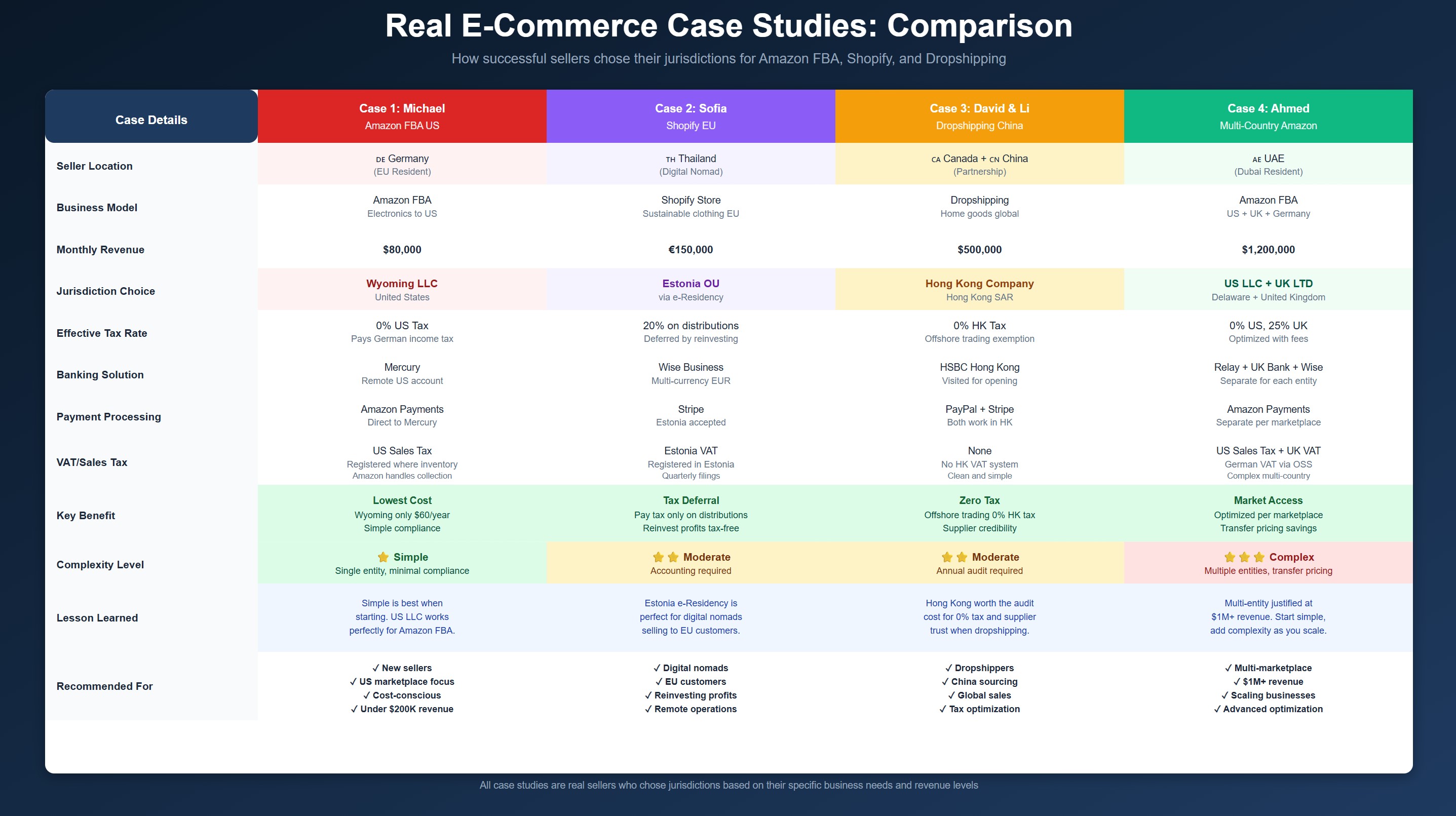
Theory is useful. Real examples show how jurisdiction choice works in practice.
Case Study 1: Michael - Amazon FBA US Seller
Background: Michael lives in Germany. He sells electronics on Amazon US marketplace. Monthly revenue around $80,000. Sources products from Chinese manufacturers.
Jurisdiction Choice: Wyoming LLC
Reasoning: Michael chose Wyoming for the lowest annual costs. He wanted a US company for Amazon marketplace access and payment processing. As a non US resident, he pays zero US federal income tax on his e-commerce profit.
Banking: Opened account with Mercury for business banking. Receives Amazon payments to US bank account. Transfers profits to his German personal account monthly.
Sales Tax: Registered for sales tax in all states where Amazon stores his inventory. Amazon handles marketplace facilitator tax collection and remittance. Michael files zero returns in most states because Amazon did everything, but registration is still required.
German Tax: Michael reports his LLC profit on his German tax return. Pays German income tax on worldwide income. The US LLC is transparent for German tax purposes. No double taxation because there is no US tax.
Result: Simple structure. Low cost. Operational simplicity. Michael runs a six figure business with minimal administrative burden.
Case Study 2: Sofia - Shopify Clothing Brand
Background: Sofia lives in Thailand (digital nomad). She runs a Shopify store selling sustainable clothing to European customers. Revenue approximately €150,000 annually. Products manufactured in Portugal.
Jurisdiction Choice: Estonia OU (via e-Residency)
Reasoning: Sofia wanted an EU company for credibility with European customers and simplified VAT. Estonia e-Residency allowed her to form and manage the company entirely online without visiting Estonia.
Tax: Estonian corporate tax is 20%, but only on distributed profits. Sofia reinvests most profit into inventory and marketing. She takes a small salary equivalent. She defers most corporate tax by not distributing profits.
VAT: Registered for Estonian VAT. Uses Shopify to collect VAT on all EU sales. Remits VAT quarterly to Estonian tax authority. Shopify provides VAT reports that make compliance straightforward.
Banking: Opened business account with Wise. Uses Wise to hold euros and accept payments through Shopify. Transfers some funds to her Thai bank for personal living expenses.
Payment Processing: Uses Stripe (available in Estonia). Transaction fees are normal EU rates. No payment holds or issues.
Result: EU company provides credibility. Tax deferral through Estonia's system allows her to scale. VAT compliance is manageable. She operates remotely from Southeast Asia with no issues.
Case Study 3: David and Li - Dropshipping from China
Background: David (Canadian) and Li (Chinese) run a dropshipping business. They source home goods from Chinese factories and sell globally through their own Shopify store. Revenue around $500,000 annually.
Jurisdiction Choice: Hong Kong company
Reasoning: Hong Kong territorial taxation exempts offshore trading from tax. Since they buy from China and sell to customers outside Hong Kong (US, Europe, Australia), profits are 0% taxed in Hong Kong. Li's Chinese connections help with supplier relationships. Hong Kong company commands more respect from suppliers than offshore alternatives.
Banking: Opened HSBC business account in Hong Kong. Visited Hong Kong for bank account opening (required). Account provides multi currency capabilities (USD, EUR, GBP, HKD). Helps manage foreign exchange efficiently.
Payment Processing: Use PayPal and Stripe (Hong Kong). Some issues with PayPal holds initially due to high volume and rapid growth, but resolved after providing documentation. Stripe works smoothly.
Tax: Hong Kong Inland Revenue Department reviewed their operations. They provided evidence (supplier invoices from China, customer shipping addresses outside Hong Kong) proving offshore nature. Received tax exemption. They pay zero Hong Kong corporate tax.
Canadian and Chinese Tax: David reports his share of profits on Canadian tax return (as foreign income). Pays Canadian tax. Li does similarly in China on her share. The Hong Kong company itself pays zero tax.
Result: Tax efficient structure. Strong supplier relationships. Good banking and payment processing. Manageable compliance. As the business scales toward $1M revenue, they are considering hiring employees and adding substance to further optimize.
Case Study 4: Ahmed - Multi Country Amazon Seller
Background: Ahmed lives in the UAE. He sells home products on Amazon US, Amazon UK, and Amazon Germany. Revenue split roughly evenly across the three marketplaces (total around $1.2M annually).
Jurisdiction Choice: Two companies - US LLC for Amazon US, UK LTD for Amazon UK and EU
Reasoning: Ahmed wanted to keep each region separate for simplicity and liability protection. US LLC handles US marketplace. UK LTD handles UK and EU marketplaces.
US LLC: Registered in Delaware (before Texas was popular). Receives Amazon US payments. Pays zero US federal tax as Ahmed is non resident. Files sales tax returns in applicable states.
UK LTD: Formed a UK limited company. Registered for UK VAT. Registered for VAT in Germany through One Stop Shop. Amazon handles most VAT collection. UK company pays 25% corporate tax on UK and EU profits.
Banking: Separate bank accounts for each entity. US LLC uses Relay. UK LTD uses UK business bank (Tide). Uses Wise to move money between entities when needed.
Tax Optimization: Ahmed keeps the US business profitable since there is no US tax. He pays himself management fees from the UK company to the US company for services provided (consulting, product research). This reduces UK taxable profit and shifts income to the zero tax US entity. Fees must be at arms length and properly documented.
Result: More complex structure but justified by revenue scale. Clear separation between US and EU operations. Tax optimized legally through transfer pricing. Ahmed plans to eventually consolidate under a holding company structure as he continues scaling.
Jurisdiction Comparison Table
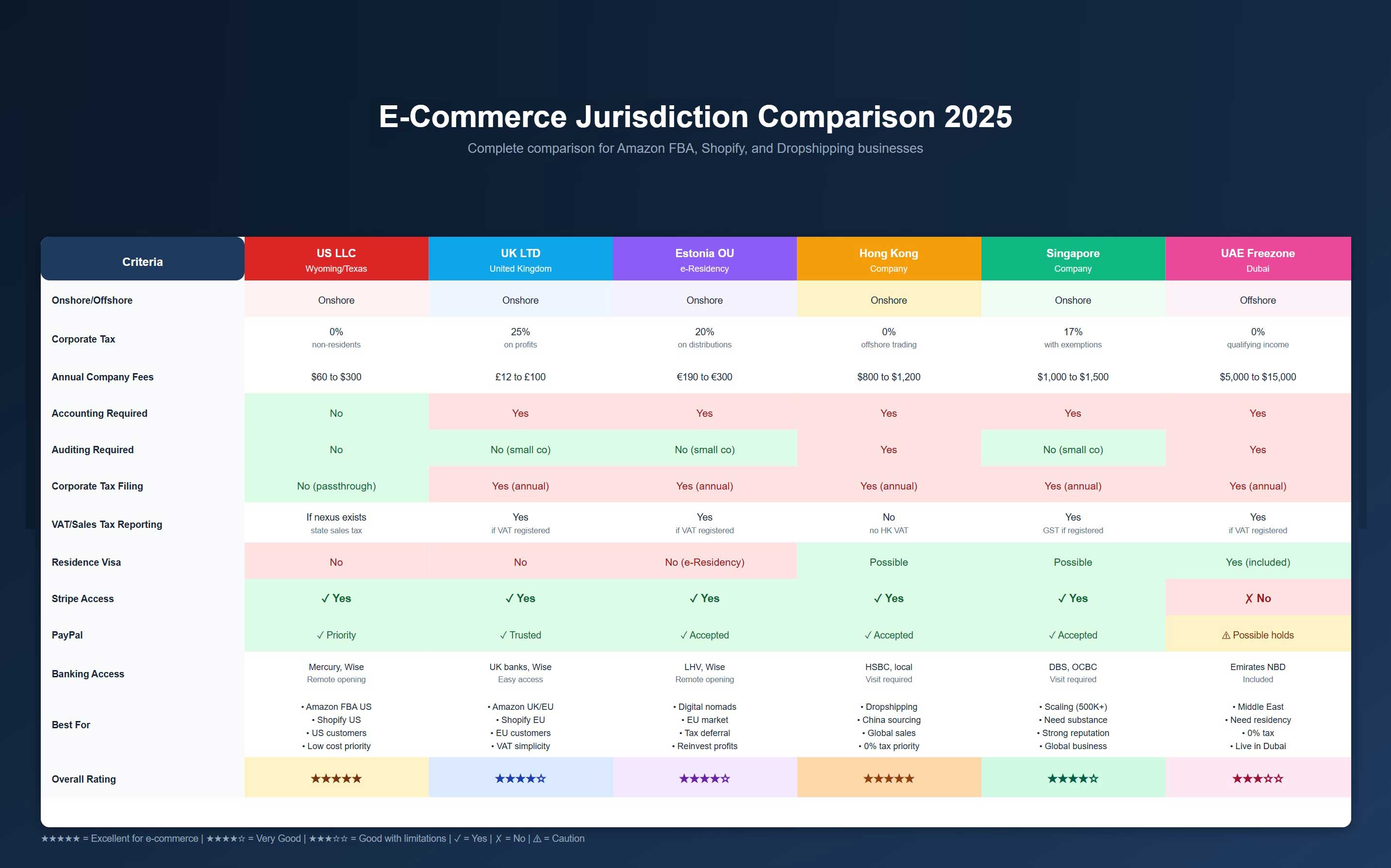
Here is a summary comparing popular jurisdictions for e-commerce businesses across key factors.
Quick Reference:
US LLC (Wyoming/Texas): Best for US marketplace access, payment processing, lowest cost. Zero US tax for non residents.
UK LTD: Best for UK and EU marketplaces, VAT simplicity. 25% corporate tax on profits.
Estonia OU: Best for EU digital nomads, tax deferral. 20% tax only on distributions, requires e-Residency.
Hong Kong Company: Best for Asian sourcing and offshore trading. 0% tax if offshore, requires visit for banking.
Singapore Company: Best for scaling businesses needing substance. 17% tax with exemptions, strong reputation.
UAE Freezone: Best for Middle East market and residency. 0% tax on qualifying income.
How to Choose Your Jurisdiction and How 1Stop Connect Helps

1Stop Connect has extensive experiecne in setting up your strcuture of need. Follow this decision framework to choose the right jurisdiction for your e-commerce business.
Step 1: Identify Your Primary Market
Where are most of your customers? If 80% of sales are to US customers, lean toward a US company. If primarily European, consider UK or Estonia. If Asian, look at Hong Kong or Singapore.
Match your company location to your customer location for credibility and operational ease.
Step 2: Check Payment Processor Requirements
Which payment processors do you need? If you must use Stripe, ensure your jurisdiction is on Stripe's approved list. If PayPal is acceptable, you have more options.
Do not choose a jurisdiction that blocks you from your required payment processor. This is a common and expensive mistake.
Step 3: Evaluate Banking Access
Can you easily open a business bank account? US LLCs allow Mercury, Relay, Wise for non residents (easy remote opening). Hong Kong and Singapore require personal visits. UAE provides banking with the freezone package.
If you cannot get banking, the jurisdiction does not work regardless of tax benefits.
Step 4: Understand Tax Implications in Your Residence Country
Where do you personally live? Most countries tax their residents on worldwide income. Forming a company in a zero tax jurisdiction often does not eliminate your personal tax liability.
Consult a tax advisor in your country to understand how foreign company profits are taxed for residents. Do not assume offshore company equals zero personal tax.
Step 5: Calculate Total Cost of Compliance
Formation cost plus annual fees plus compliance (accounting, audits, filings). A cheap formation can become expensive with annual compliance.
Wyoming LLC: $60 annual (simple). Hong Kong company: $2,500 annual including audit and secretary (more complex). Factor these into your decision.
Step 6: Consider Future Plans
Where do you want to be in 3 to 5 years? If you plan to raise venture capital, Delaware LLC or local country company may be better even if tax is higher. Investors often require this.
If you want to scale internationally, a structure that accommodates multiple entities (holding company plus operating companies) may be worth considering from the start.
Step 7: Start Simple, Optimize Later
Especially for new businesses under $100,000 revenue: Do not overcomplicate things. A simple structure in a reputable jurisdiction is better than a complex offshore setup.
You can always restructure later as the business proves itself and revenue grows. Starting with complexity when you do not even have product market fit is premature.
Most e-commerce entrepreneurs overthink jurisdiction choice early on. Focus first on product market fit and sales growth. A simple US LLC or home country company works fine until $200,000+ revenue.
Avoid offshore structures unless you understand substance requirements and banking challenges. Payment processor access is more important than tax optimization for online businesses.
Once your business is proven and revenue is substantial, then optimize. Hire professionals to structure it properly. Do not let jurisdiction choice paralyze you from launching.
Honest Assessment
1Stop Connect tells you when a jurisdiction is not appropriate for your situation. If you are a US person, we explain why an offshore company provides no tax benefit and may create complications. If you are better served forming in your home country, we say so. We prefer you succeed with the right structure rather than form a company that creates problems later.