
When clients tell me they are looking at the Americas for their next company, they usually mean Delaware or Wyoming. Occasionally Panama. Almost never Costa Rica. That is a mistake worth correcting.
Costa Rica is a small country of around 5.2 million people nestled between Nicaragua and Panama, with Pacific and Caribbean coastlines and an Arenal volcano backdrop that makes most European business parks look drab. More importantly, it offers something increasingly rare: a stable democratic republic with over 70 years of continuous civilian government, no standing army since 1948, an independent judiciary with real teeth, and a legal system that robustly protects foreign investors and intellectual property.
Add a territorial tax system that excludes foreign-source income from local taxation, a Free Trade Zone regime with exemptions that rival Singapore's, a 97%+ literacy rate, a deep pool of bilingual talent, and a strategic location bridging North and South America, and you have a jurisdiction that belongs in every serious founder's shortlist. This guide covers what you actually need to know.
- Why Costa Rica? The Quick Numbers
- Company Structures: SA vs SRL
- Offshore Companies: The Sociedad Anónima in Detail
- Tax System: Territorial, FTZ and Standard
- Free Trade Zone Regime: Law 7210
- How to Register a Company
- Banking Reality
- Industries and Who Is Already Here
- Residency and Visa Options
- Frequently Asked Questions
Why Costa Rica? The Quick Numbers
Costa Rica's business case rests on five pillars: political stability, territorial taxation, an educated bilingual workforce, strong trade agreements, and a Free Trade Zone regime that has attracted some of the world's largest multinationals. The World Bank consistently ranks it among the top performers in Latin America for investor protections and business environment. It is not a tax haven; it is a legitimate, transparent jurisdiction that simply does not tax income earned outside its borders.
The numbers that matter to my clients:
- 0% tax on foreign-source income under the territorial tax system: a properly structured SA earning all revenue from outside Costa Rica pays zero local corporate tax on those profits
- Standard corporate rate: 30% on Costa Rican-source net income for larger companies; graduated lower rates apply to smaller companies below the threshold
- MIPYME relief: 0% for the first 3 years for registered micro and small businesses; reduced rates in subsequent years
- Free Trade Zone (FTZ): up to 100% exemption from corporate income tax for 8–12 years, plus import duty and VAT exemptions, under Law No. 7210
- No wealth, inheritance or capital gains tax in most standard holding structures
- Minimum capital: low nominal capital requirement for an SA (largely unpaid in practice)
- 50+ bilateral trade agreements including with the USA, EU, Canada, Singapore, China, Mexico, and Chile

Company Structures: SA vs SRL
Costa Rica offers two main corporate vehicles for foreign founders. Choosing between them is straightforward once you understand the difference.
Sociedad Anónima (SA) — Corporation
The SA is Costa Rica's equivalent of a corporation or public limited company. It is the standard choice for offshore holding structures, international trading companies, asset protection vehicles, and any business that may eventually bring in external investors or issue shares to multiple parties. Key characteristics:
- Governed by a formal board of directors (minimum 3 directors: president, secretary, treasurer) and a fiscal agent
- Minimum 2 shareholders at incorporation; shares are freely transferable
- Low nominal minimum capital requirement, which can remain unpaid
- 100% foreign ownership permitted: no Costa Rican partner, director, or employee required
- Shares must now be registered with the Central Bank's Beneficial Ownership Registry (BCCR), ending the old bearer share anonymity era
- Well understood by international banks, law firms, and counterparties globally
Sociedad de Responsabilidad Limitada (SRL) — Limited Liability Company
The SRL is simpler and better suited to solo operators, small partnerships, or businesses that do not anticipate external investment. Key differences from the SA:
- Managed by one or more gerentes (managers) rather than a formal board
- Quotas (membership interests) are not freely transferable without the consent of other members
- Lower governance overhead and cheaper to maintain annually
- Identical tax treatment to the SA under Costa Rican law
- Less familiar to international banks and counterparties
Offshore holding / international trade / multiple shareholders: SA → maximum flexibility, global recognition, clean share transfer mechanism.
Solo founder, small service business, low complexity: SRL → cheaper to maintain, faster to manage.
Manufacturing, IT services, shared services targeting FTZ incentives: SA inside a Free Trade Zone park → Law 7210 incentives apply.
Startup building toward external investment: SA → shares can be restructured for investor rounds.
Offshore Companies: The Sociedad Anónima in Detail
The offshore use case for a Costa Rican SA is well-established and legitimate. Let me be precise about what it means and what it does not mean.
Costa Rica applies a territorial tax system: only income whose source is within Costa Rica is subject to local corporate income tax. A company that provides consulting services to European clients, holds investments in foreign assets, or operates an e-commerce business serving North American customers — and issues no invoices within Costa Rica — can legally generate that income without triggering local corporate tax on it. This is not a loophole; it is the deliberate design of Costa Rican tax law, confirmed by the PwC 2026 Costa Rica Tax Summary.

San José's business district — the financial and corporate hub of Costa Rica.
What the offshore SA gives you:
- Asset protection: Assets held by an SA are legally separated from your personal estate. The SA can hold foreign real estate, intellectual property, investment portfolios, or shares in other companies.
- Territorial tax benefit: Foreign-source income not taxed locally, as described above.
- Privacy (limited): Since 2019, beneficial owners of Costa Rican companies must register with the BCCR. Registered details are accessible to authorities but not publicly searchable. This is comparable to most EU jurisdictions today.
- Trade agreement access: Costa Rican companies can utilise the country's free trade agreements with the USA, EU, Singapore, Canada, China, Mexico, and Chile.
- No minimum activity requirement: A dormant SA can be maintained as a holding vehicle with low annual overhead.
- VASP / Gaming licensing: Costa Rica has well-defined (if lightly regulated) frameworks for online gaming and virtual asset service providers (VASPs), making the SA a popular vehicle for these sectors.
It is not invisible. BCCR beneficial ownership registration means Costa Rican authorities know who owns the company. FATF-compliant banks will ask for the same information. The old bearer-share era is over.
Your home country's rules still apply to you. If you are a tax resident of Germany, France, the UK, or most EU countries, your home jurisdiction's Controlled Foreign Company (CFC) rules may tax the SA's retained profits as your personal income regardless of Costa Rica's territorial system. Always verify both sides of the equation before structuring.
No local invoicing. The moment the SA begins issuing invoices for work performed within Costa Rica or to Costa Rican clients, that income becomes Costa Rican-source and is taxable. The structure must be maintained consistently.
Tax System: Territorial, FTZ and Standard
Costa Rica's tax system has three meaningful modes for a foreign-founded business. Here they are side by side:
| Regime | Corporate Tax | Dividend WHT | Best For |
|---|---|---|---|
| Territorial (offshore SA) | 0% on foreign-source income | 15% on Costa Rican-source dividends | Holding, international trade, offshore services |
| Standard (local operations) | 30% on net income (large co.) or graduated lower rates (small co.) | 15% | Domestic businesses, local service companies |
| MIPYME (micro/small biz) | 0% years 1–3; 25% of normal in years 4–5; 50% year 6 | 15% | New small businesses registered with MEIC or MAG |
| Free Trade Zone (FTZ) | 0–100% exemption for 8–12 years | Exempt within zone | Manufacturers, IT exporters, shared services |
A note on the 2023 passive income reform: Costa Rica's tax authority introduced a rule targeting large multinational group companies without genuine local substance. If your company is part of a multinational structure and lacks demonstrable local operations, passive income (dividends, interest, royalties from foreign sources) may become taxable in Costa Rica. This affects large corporate groups, not typical SME offshore structures. Confirm your position with a local tax advisor.
The standard withholding tax on dividends paid to non-resident shareholders is 15%, potentially reduced under a bilateral tax treaty. Costa Rica has a growing treaty network; check the current status at PwC Tax Summaries.
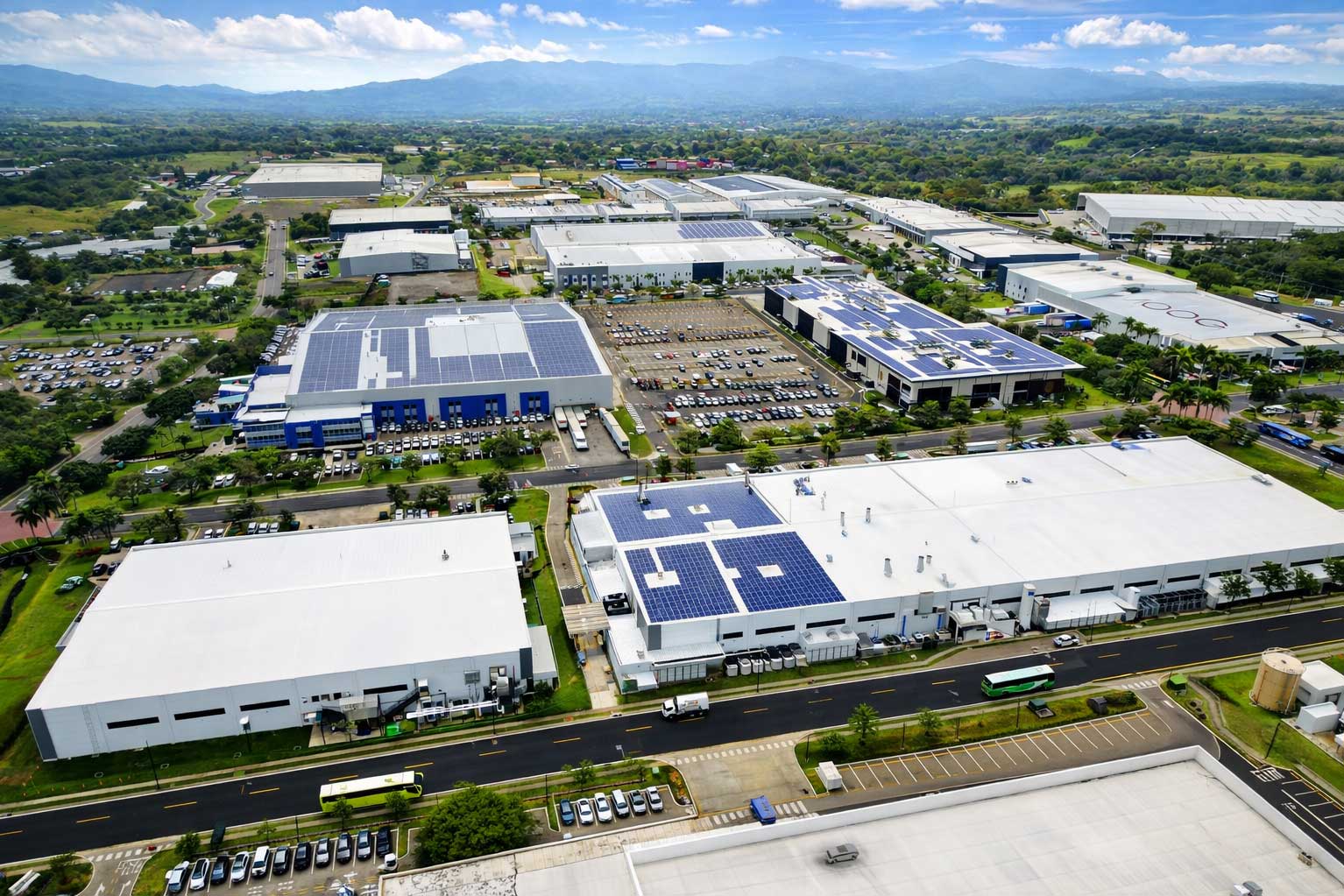
Coyol Free Zone in Alajuela — home to Boston Scientific, Abbott, and over 60 multinational companies.
Free Trade Zone Regime: Law 7210
This is where Costa Rica genuinely distinguishes itself from most Latin American competitors. The Free Trade Zone (FTZ) regime, governed by Law No. 7210 and administered by PROCOMER and CINDE, offers a package of fiscal incentives that has attracted companies like Intel, HP, Amazon Web Services, Boston Scientific, Johnson & Johnson, and Pfizer to establish significant operations in the country.
What FTZ status gives you:
- Corporate income tax exemption: 100% exemption for the first 8 years; 50% for years 9–12 for companies in the Greater Metropolitan Area (GMA). Companies outside the GMA receive extended periods — up to 12 years at 100% then 50% for a further 6 years.
- Import duty exemption: Raw materials, machinery, equipment, spare parts, and packaging materials imported for FTZ operations enter duty-free.
- VAT and excise duty exemptions on inputs and outputs within the zone
- Simplified customs procedures: Dedicated customs regimes for FTZ operators speed up clearance significantly
- No foreign exchange restrictions: FTZ companies can hold and operate in any currency
Qualifying sectors include manufacturing (electronics, medical devices, aerospace components), IT services and software development, shared service centres, R&D facilities, and logistics operations. Companies must meet minimum investment thresholds and commit to a certain level of employment. CINDE, the Costa Rican Investment Promotion Agency, is the starting point for any FTZ application and provides free advisory services to prospective investors.
Boston Scientific, Abbott, Johnson & Johnson, Pfizer, Intel, HP, Amazon Web Services, Accenture, and Western Union all have significant Costa Rica FTZ operations. The country has become the world's leading exporter of medical devices per capita, with the sector generating over $4 billion in annual exports. This is not a speculative jurisdiction: it has a proven, decades-long track record of hosting serious multinationals under a stable legal and fiscal framework.
How to Register a Company
Unlike Georgia, where you can walk out of a government office with a registered LLC in a day, Costa Rica requires more process. This is not a drawback — it reflects the country's more comprehensive legal framework. The process involves name reservation at the National Registry, drafting and notarising the corporate deed through a licensed Costa Rican attorney, registration at the Registro Nacional, and subsequent registrations with the tax authority (Hacienda) and the Central Bank's beneficial ownership registry. If you are hiring locally, registration with the social security authority (CAJA) follows.
Non-residents cannot act as their own incorporator and must work with a licensed Costa Rican attorney throughout. Remote incorporation via power of attorney is fully supported — no travel to Costa Rica is required. Total time from start to fully operational company is typically 4–8 weeks, depending on the structure and documentation.
Navigating the Costa Rican registration process, attorney selection, banking, and beneficial ownership filings is straightforward with the right guidance. 1Stop Connect assists clients with company formation across Costa Rica and more than 30 jurisdictions worldwide. Get in touch to discuss your structure.

The Central Valley's coffee plantations — agriculture and technology side by side.
Banking Reality
Banking is where most people's experience of Costa Rica diverges from the marketing brochure. Let me be direct.
Costa Rica has two state-owned banks — Banco de Costa Rica (BCR) and Banco Nacional — and a range of private banks including BAC Credomatic, Scotiabank, and Davivienda. For foreign-owned companies:
- State banks are more accommodating to foreign-owned corporate accounts but require extensive documentation: corporate deed, beneficial ownership certificate, source of funds declaration, business description, client contracts or letters of intent, and full KYC on all directors and shareholders. An opening deposit is typically required.
- Private banks often require a local business relationship, proof of Costa Rican-source activity, or a minimum opening deposit. Some decline foreign-owned offshore structures entirely.
- Account opening timeline: Anywhere from 2 weeks to 3 months depending on the bank, your business profile, and the complexity of your structure. Non-standard profiles (crypto-adjacent businesses, certain nationalities, complex ownership chains) face longer processing.
- International wire restrictions: Some Costa Rican banks impose limits on outbound international transfers. Confirm wire capabilities before choosing a bank.
For a pure offshore SA with no local operations, the realistic approach is to hold the Costa Rican entity itself and open the working bank account in the USA, Europe, or another jurisdiction with better correspondent banking. The SA structure remains valid regardless of where the operational bank account is held.
Industries and Who Is Already Here
Costa Rica's economic diversification over the past 30 years is one of the most successful in Latin America. It has moved from an agricultural economy to one of the world's leading exporters of medical devices, with a growing technology and shared-services sector alongside its legacy agriculture and tourism base.
Advanced Manufacturing & Medical Devices
Costa Rica is, by most measures, the world's leading medical device exporter per capita. Companies including Boston Scientific, Johnson & Johnson, Abbott, Pfizer, Medtronic, and Allergan operate major manufacturing and R&D facilities here, almost universally under the FTZ regime. The skilled workforce, strong IP protections, and FDA-familiar regulatory environment are the key draws.
Technology & Shared Services
Intel established its Costa Rica campus in 1997 and triggered a wave of tech investment that continues today. Amazon Web Services, HP, Accenture, Cognizant, Sykes (now TTEC), and Western Union all operate significant shared service centres or tech hubs here. The bilingual talent pool — competitive rates in the US time zone — is the core commercial proposition.
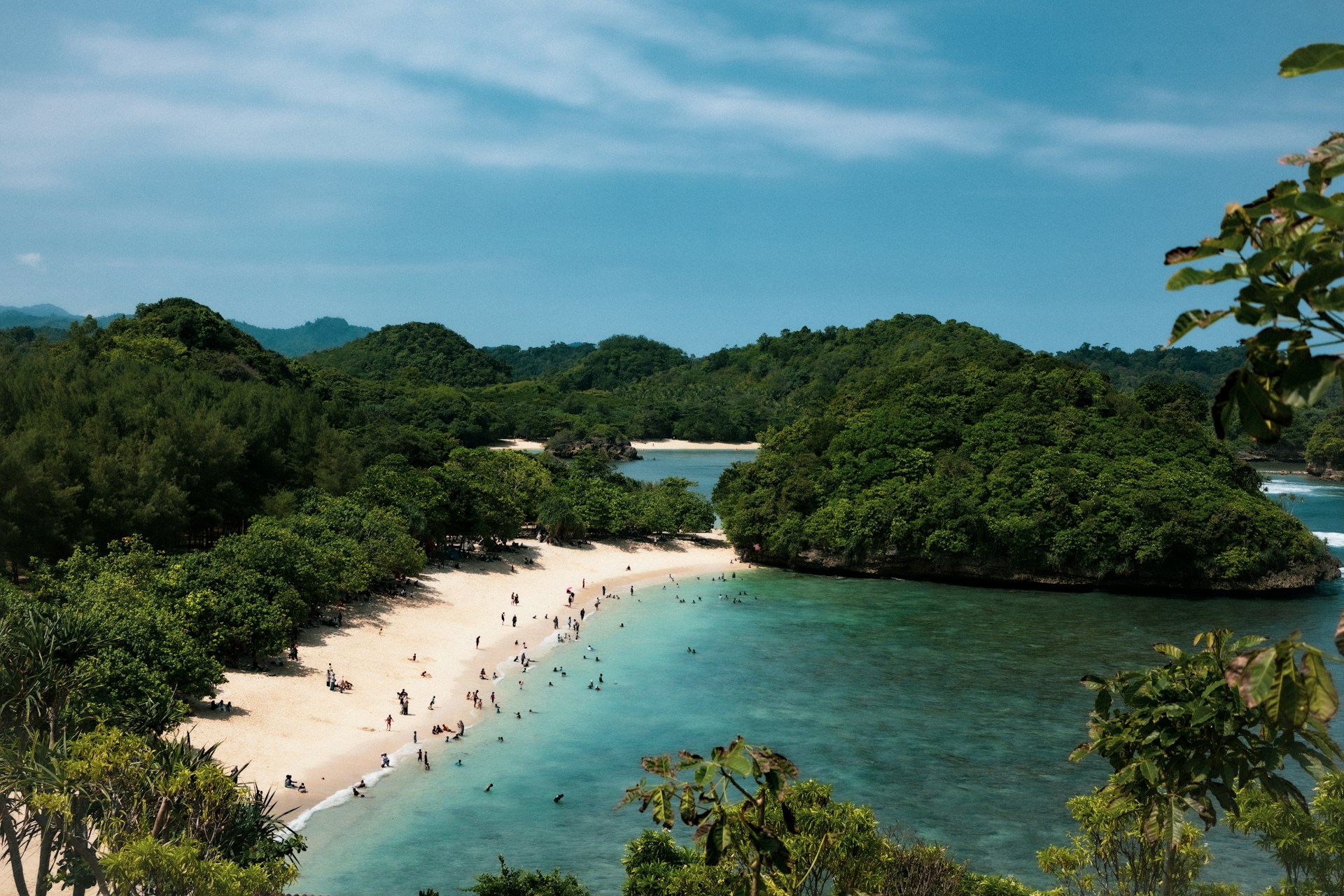
Manuel Antonio on the Pacific coast — world-class eco-tourism alongside a thriving tech economy.
Eco-Tourism & Hospitality
Costa Rica pioneered the eco-tourism model and remains one of the world's top sustainable tourism destinations. Boutique hotels, wellness retreats, surf camps, and adventure tourism operations are a significant part of the economy. Foreign-owned tourism businesses are common and well understood by the local legal and banking system.
Fintech, VASP & Online Gaming
Costa Rica has long been a preferred jurisdiction for online gaming operations, with a lightly regulated but legally recognised framework. The country is increasingly attracting fintech and VASP (Virtual Asset Service Provider) businesses that need a legitimate Central American incorporation with access to US-time-zone talent. The SA structure is the standard vehicle for these sectors.
Residency and Visa Options
Costa Rica offers four main residency pathways for entrepreneurs, investors, and professionals. All four lead to permanent residency after 3 years and citizenship eligibility after 7 years (5 years for certain nationalities). There is no requirement to live exclusively in Costa Rica while holding temporary residency, though some categories require a minimum annual presence.
| Visa Type | Requirement | Initial Term | Key Notes |
|---|---|---|---|
| Pensionado | Minimum monthly pension income | 2 years, renewable | Government, Social Security, private pension or annuity all qualify |
| Rentista | Minimum monthly passive income | 2 years, renewable | Often met with a certified bank deposit; requires 4 months/year presence |
| Inversionista (Investor) | Minimum qualifying investment | 2 years, renewable | Investment must be in personal name; 4–9 months processing |
| Digital Nomad | Minimum monthly income from foreign clients (higher threshold for families) | 1 year, renewable once | Cannot work for Costa Rican companies; requires bank statements and qualifying health insurance |
The Inversionista visa is the most relevant for founders incorporating an SA. The minimum investment can be satisfied through the company's capitalisation, real estate purchase, or other qualifying assets. The Digital Nomad visa is straightforward for remote workers and consultants but does not in itself permit operating a local business. Processing times across all categories typically run 4–12 months through the Dirección General de Migración y Extranjería.
Citizens of many nationalities can enter Costa Rica visa-free for up to 90 days (extendable once to 180 days with a simple border run). This gives you a reasonable window to explore, incorporate, and begin the residency application process before needing to formalise your status.
San José is significantly more affordable than most Western European or North American cities. The premium business neighbourhoods — Escazú and Santa Ana — offer well-equipped apartments and modern coworking spaces at a fraction of comparable Western cities. The Pacific and Caribbean beach towns are more affordable still. For founders building a team, the combination of skilled bilingual talent and a lower overall cost base creates a compelling proposition versus building in the USA or UK.

San José's modern office parks host shared service centres and multinational tech operations.
Frequently Asked Questions
Is Costa Rica a tax haven?
Costa Rica is not a tax haven in the traditional sense. It is a fully cooperative, OECD-engaged jurisdiction that participates in the Common Reporting Standard (CRS) and automatic exchange of financial information. What it does have is a territorial tax system: income whose source is outside Costa Rica is generally not subject to local corporate income tax. A properly structured SA earning entirely foreign-source income does not pay Costa Rican corporate tax on those profits. This is deliberate policy, not a loophole, and it is confirmed annually by the country's tax authority and PwC's tax summaries. The key distinction: you are still liable for taxes in your home country on your personal income and potentially on the company's retained profits under CFC rules.
What is the best company structure for offshore use?
The Sociedad Anónima (SA) is the standard vehicle for offshore holding, international trading, and asset protection. It is well recognised internationally, allows flexible share structures, and is the preferred form for banking relationships and investor documentation. The SRL is simpler and cheaper but less flexible. For manufacturing or IT services targeting FTZ incentives, an SA inside a qualified Free Trade Zone park is the optimal structure under Law 7210.
How long does company registration take?
A standard SA registration takes 4–6 weeks from engagement of your attorney to receipt of your tax ID. The National Registry processing step takes 5–10 business days. Remote incorporation adds 1–2 weeks for power of attorney preparation, notarisation, apostille, and certified translation. Bank account opening is a separate process that can take anywhere from 2 weeks to 3 months. Total time from decision to fully operational company with a working bank account: typically 6–10 weeks if your documentation is straightforward.
What residency options does Costa Rica offer for investors?
The four main pathways are: Pensionado (guaranteed pension income); Rentista (passive income); Inversionista (qualifying investment); and Digital Nomad (income from foreign clients). All lead to permanent residency after 3 years. Processing times are 4–12 months through the immigration authority. Citizens of many nationalities can enter visa-free for 90 days, giving time to begin the application process before needing to formalise status. For more options across other jurisdictions, see our services page.
What are the main Free Trade Zone benefits?
Under Law 7210, FTZ companies operating in the Greater Metropolitan Area receive 100% corporate income tax exemption for 8 years, then 50% for years 9–12. Companies outside the GMA receive extended periods (12 years at 100% then 50% for 6 more years). Additional benefits include: exemption from import duties on all inputs; VAT and excise duty exemptions; no foreign exchange restrictions; and simplified customs procedures. Qualifying sectors include manufacturing, IT services, shared service centres, R&D, and logistics. CINDE provides free advisory services to prospective FTZ investors at cinde.org.